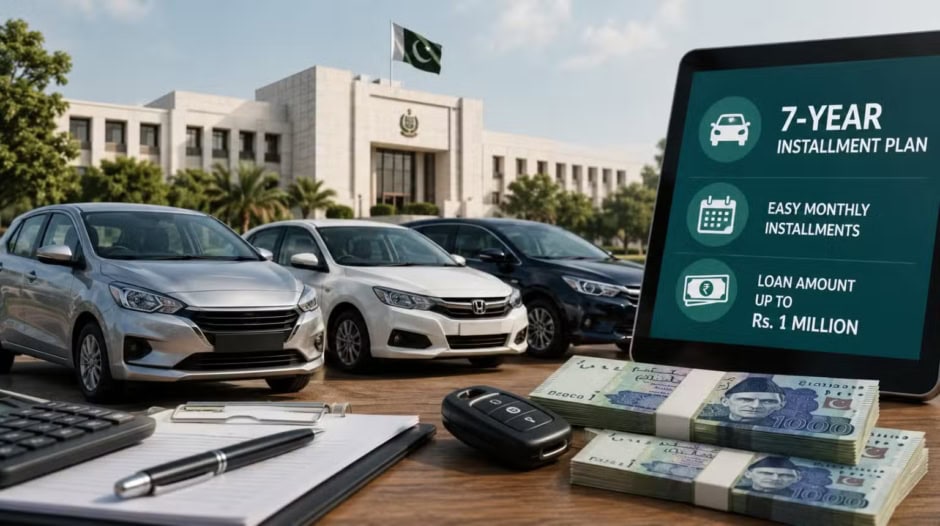
The federal government is considering a major overhaul of auto financing rules that would allow long-term car installment plans of up to seven years and increase vehicle financing limits to as high as Rs. 10 million, according to official sources.
The proposals are part of the draft Auto Industry Development & Export Policy (AIDEP) 2026–31, which is currently under review in consultation with the State Bank of Pakistan and industry stakeholders.
Sources said the measures aim to revive car financing demand, improve affordability, and support recovery in Pakistan’s automobile sector after a prolonged slowdown caused by high interest rates, strict lending conditions, and rising vehicle prices.
Under the proposed framework, auto financing tenure would be extended from current limits to up to seven years, while the minimum down payment requirement may be reduced to 15 percent. A financing cap of Rs. 10 million is also being proposed for eligible locally manufactured vehicles.
Officials said the reforms are designed to restore consumer purchasing power and stimulate demand in the domestic auto market.
The draft policy also proposes regulated liberalization of used vehicle imports, including mandatory inspection and certification requirements, along with a gradual reduction in tariffs from 40 percent to zero by FY2030 and a 30 percent depreciation cap.
To protect consumers, the proposals include fixed booking prices, penalties for delayed delivery beyond 30 days linked to KIBOR plus 3 percent, a 20 percent cap on advance booking payments, and warranty obligations placed on original manufacturers or authorized importers.
Additionally, a 20 percent maximum markup limit on spare parts at authorized dealerships has been suggested.
Sources said easier financing conditions could significantly boost vehicle demand and support growth across the broader auto supply chain, including parts manufacturers and vendors.
The policy’s broader targets by 2031 include annual vehicle production exceeding 500,000 units, $1 billion in auto exports, and a 30 percent share of new energy vehicles (NEVs) in total sales.
It also proposes major tariff rationalization, including phasing out additional customs duties by FY2029 and reducing regulatory duties by 80 percent by FY2030.
The draft further outlines plans for expanding electric vehicle infrastructure, including the establishment of 3,000 EV charging stations nationwide by 2030 and incentives to encourage NEV adoption.
Officials clarified that the proposals are still in draft form and will be finalized after regulatory review, banking sector consultations, and cabinet committee approvals.