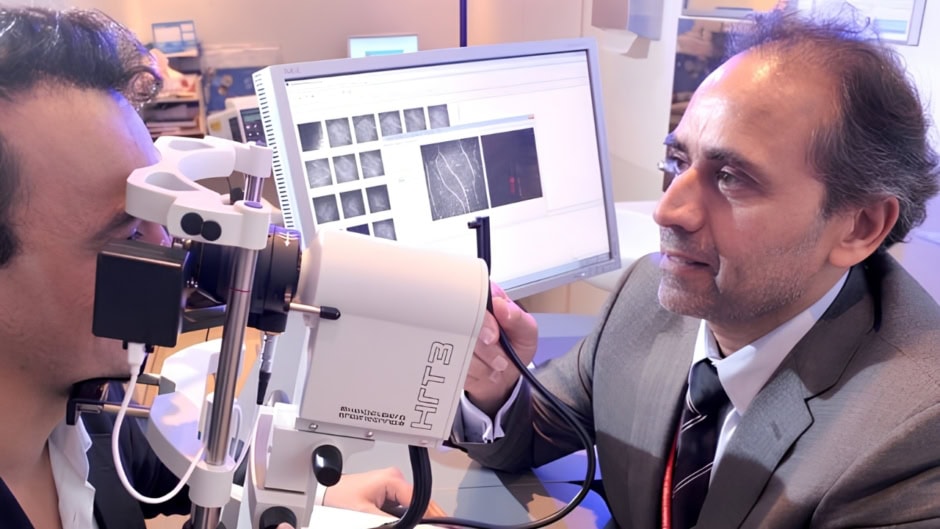
Professor Rayaz Malik, a British-Pakistani scientist based in Qatar, has pioneered a groundbreaking medical technology. He has developed an AI-powered eye scan that lasts just two to three minutes. Consequently, doctors can now detect dementia and diabetic nerve damage years before symptoms even appear. Professor Malik leads research in diabetic neuropathy and neurodegenerative diseases at Weill Cornell Medicine-Qatar (WCM-Q). He states this technology will transform early diagnosis and treatment globally.
Spotting Disease Via An AI Eye Scan
Researchers utilize a technology called corneal confocal microscopy (CCM). Traditionally, ophthalmologists and optometrists used CCM to diagnose infections in the front surface of the eye. However, Professor Malik and his colleagues discovered a revolutionary alternative application. They found that CCM detects microscopic nerve fiber damage linked to diseases far beyond the eye itself.
The cornea contains the richest sensory innervation in the human body. We evolved this dense network of nerves to protect our vision. Therefore, the cornea provides a unique window into diseases affecting the entire nervous system.
When a patient visits a doctor with memory loss and receives a dementia diagnosis, the underlying nerve damage has already developed for 10 to 15 years. At this advanced stage, standard treatments remain largely ineffective. Furthermore, MRI scans typically only show abnormalities in advanced dementia. Conversely, CCM identifies abnormal corneal nerves during mild cognitive impairment. Many of these patients develop dementia within five years.
Similarly, doctors can detect diabetic neuropathy up to five years earlier through CCM scans. Early detection remains crucial. Patients can initiate nerve repair early through weight loss, controlled blood glucose, lower lipids, and reduced blood pressure.
AI As A Medical Game Changer
Artificial intelligence drastically enhances the power of this technology. Previously, manual analysis required a significant amount of time. Now, AI processes the images in mere seconds. A human doctor might identify three or four features in a nerve image. Meanwhile, AI analyzes more than 2,500 features and learns patterns associated with specific diseases.
Consequently, AI systems now identify the underlying neurodegenerative disease with 90 to 95 percent certainty. In specific studies involving diabetic neuropathy and Parkinson’s disease, researchers achieved nearly 100 percent sensitivity and specificity. Interestingly, the origins of both AI and confocal microscopy intersect perfectly here. Marvin Minsky, a pioneer of artificial intelligence at MIT, originally invented the confocal microscope in the 1950s.
Overcoming Roadblocks For Global Impact
Despite promising results, widespread adoption faced stiff resistance. Initially, neurologists doubted that an endocrinologist could use an eye scan to diagnose neurological diseases. Additionally, limited equipment availability stalled progress. For years, only one German manufacturer produced CCM machines.
Fortunately, a Chinese company now manufactures new CCM devices. This development makes the machines much more accessible and affordable worldwide. Consequently, this breakthrough will heavily benefit developing countries like Pakistan. As diabetes rates continue to rise rapidly in the region, this British-Pakistani scientist’s innovation provides vital diagnostic relief for struggling healthcare systems.