The federal government has reduced total subsidies by 8 percent to Rs1,091 billion for fiscal year 2026-27, down from Rs1,186 billion allocated in the outgoing year.
Actual spending in FY2026 stood at Rs1,157 billion, below the budgeted figure, largely due to a decline in electricity-related subsidies.
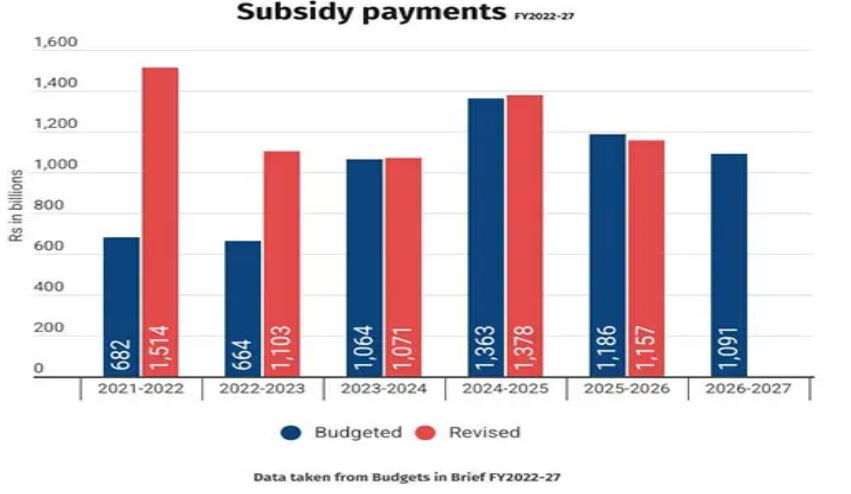
A new budget head, the PM Apna Ghar Programme, has been created for FY2027 with an allocation of Rs71 billion. An additional Rs127 billion was spent in FY2026 under the prime minister’s austerity measures outside the formal budget, amid regional tensions following the US-Israeli war on Iran.
Power Sector
The electricity subsidy has been cut from Rs1,036 billion in FY2026 to Rs830 billion in FY2027. Actual spending on power sector subsidies in the outgoing year reached Rs893 billion against the budgeted Rs1,036 billion.
The inter-Disco tariff differential subsidy has been marginally reduced from Rs249 billion to Rs248 billion.
The subsidy for merged districts of Khyber Pakhtunkhwa, formerly Fata, has been cut from Rs40 billion to Rs34 billion. The tariff differential subsidy for Azad Kashmir has, however, been increased from Rs74 billion to Rs81 billion.
The allocation for the Pakistan Energy Revolving Fund remains unchanged at Rs48 billion. The subsidy for agricultural tube wells in Balochistan has been reduced from Rs4 billion to Rs3 billion.
K-Electric’s tariff differential subsidy has been raised from Rs125 billion in FY2026 to Rs163 billion in FY2027. Its subsidy for agricultural tube wells in Balochistan remains unchanged at Rs1 billion.
No allocation has been made for independent power producers in FY2027. Payments to IPPs stood at Rs95 billion in the original FY2026 budget but were revised upward to Rs200 billion by year-end.
The allocation for containment of circular debt has been set at Rs252 billion for FY2027. The lump sum provision for power subsidy related to circular debt was Rs400 billion in FY2026 before being revised down to Rs152 billion by year-end.
Food, Agriculture and Industries
The food subsidy for the Pakistan Agricultural Storage and Services Corporation has been reduced from Rs20 billion to Rs19 billion.
Within this, the subsidy for wheat reserve stocks has been cut from Rs14 billion to Rs9.5 billion, while the subsidy for the cost differential on wheat sales has been raised from Rs6 billion to Rs9.5 billion.
The subsidy for industries and production has been increased to Rs37 billion in FY2027, up from a revised Rs12 billion in FY2026. This includes Rs5.8 billion for the production and supply of urea fertiliser and Rs8 billion as an incentive under the Electric Vehicle Scheme.