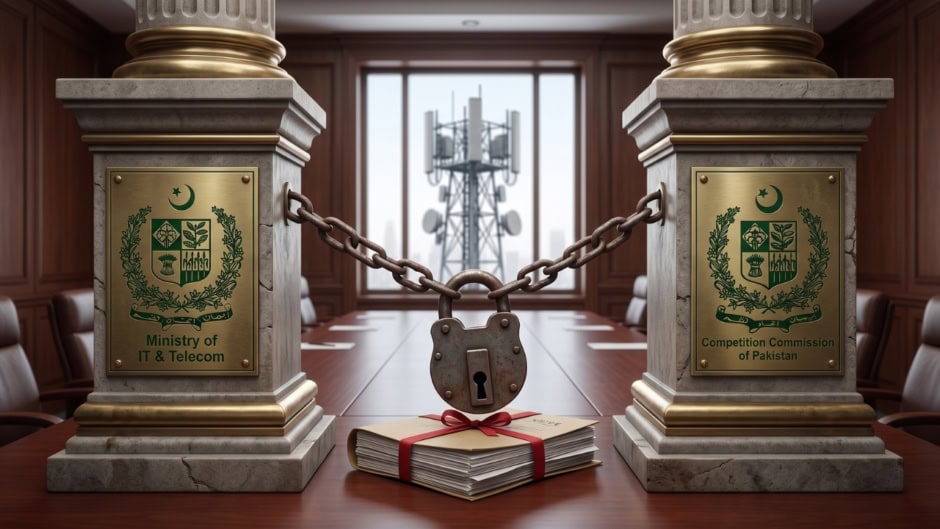
For a decade, Pakistan’s telecom sector has waited for dedicated competition rules. However, a relentless jurisdictional dispute between the Ministry of Information Technology and Telecommunication (MoITT) and the Competition Commission of Pakistan (CCP) continues to block progress. Official documents confirm that the primary hurdle is a bitter disagreement over legal authority.
A Decade of Drafts & Delays: MoITT & CCP Dispute
The core conflict centers on which institution actually possesses the mandate to frame these rules. According to the Pakistan Telecommunication Authority (PTA), Section 57 of the Pakistan Telecommunication (Re-organization) Act and Clause 5.1.2 of the Telecom Policy 2015 specifically empower the federal government and MoITT to draft the framework.
Consequently, the PTA submitted its initial draft to the ministry back in 2016. Furthermore, MoITT conducted public consultations between 2017 and 2018. The ministry then forwarded the draft to the Ministry of Law and Justice for legal vetting. Meanwhile, the PTA repeatedly urged the ministry to expedite the process.
To push things forward, the regulator submitted an updated draft in 2022. Fast forward to this year, and the bureaucratic back-and-forth continues. The MoITT circulated a revised draft in January 2026, prompting PTA’s comments in March. Most recently, the ministry shared yet another draft on July 7, 2026. In response, the PTA submitted its latest feedback on July 27, just a couple of weeks ago.
The Islamabad High Court Steps In
Conversely, the CCP firmly rejects MoITT’s mandate. The commission argues that competition regulation falls strictly within its own jurisdiction.
Ultimately, the Islamabad High Court (IHC) intervened to settle the matter. On November 1, 2025, the IHC delivered a comprehensive ruling backing the CCP. The court explicitly dismissed petitions from major telecom operators, including Jazz, Telenor, Zong, Ufone, and PTCL. These companies had previously challenged the commission’s authority.
However, the court ruled that the CCP holds overarching jurisdiction across all economic sectors, including telecommunications. The judgment clarified that the Competition Act, 2010, and the Pakistan Telecommunication (Re-organization) Act, 1996, operate in distinct yet complementary domains. Therefore, while the PTA regulates technical and operational matters, the CCP holds the statutory mandate to prohibit anti-competitive conduct, collusive arrangements, abuse of dominance, and deceptive marketing.
5G & Digital Investments at Risk
Despite this clear ruling and multiple recent meetings, the rules remain stuck in limbo. Consequently, Pakistan’s telecom sector lacks the dedicated framework initially envisioned under the Telecom Policy 2015.
Industry observers warn that this absence prolongs dangerous regulatory uncertainty. Right now, the telecom market is undergoing heavy consolidation. Furthermore, operators are preparing for next-generation technologies like 5G deployment.
This ongoing delay directly undermines broader government reforms designed to attract much-needed investment into Pakistan’s digital economy. Officials add that until MoITT and the CCP finally resolve this institutional gridlock, the long-awaited Telecom Competition Rules will likely never see the light of day.