US company Soteria Battery Innovation Group has licensed a new battery technology from Rutgers University. The current collector technology aims to improve the safety and durability of lithium-ion batteries. It targets a problem that worsens as cells age.
The issue is electrode cracking and separation over time. Batteries expand and contract during repeated charge and discharge cycles. That stress cracks electrodes and weakens their contact with the current collector. The result is higher resistance, excess heat, and faster degradation.
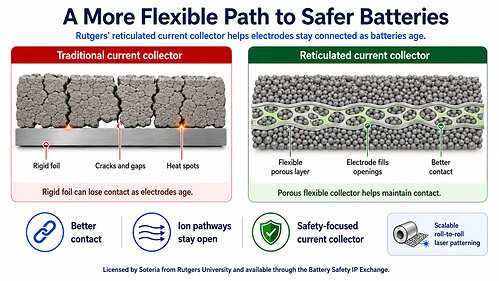
Researcher Glen Amatucci developed the patented design at Rutgers. His team created a reticulated current collector to ease that stress. The design replaces traditional solid metal foils with a new structure. It uses a lightweight, porous polymer coated in thin conductive metal layers.
As per their official statement:
The three-dimensional design is intended to improve flexibility, reduce weight, enhance current distribution, support electrolyte transport, and help mitigate resistance growth and heat generation as batteries age.
The flexible architecture better handles electrode expansion and contraction. Built on a three-dimensional structure, it improves flexibility while cutting weight. It also enables more uniform current distribution across the cell. That helps limit resistance buildup and heat generation as batteries age.
The work matters more as energy density rises. Battery makers keep pushing cells to store more power. Maintaining electrode stability becomes critical to both performance and safety. Current collectors remain an often overlooked part of that equation.
“We believe that current collectors are an underappreciated opportunity to improve battery safety and performance,” said Brian Morin, CEO of Soteria Battery Innovation Group. “The Rutgers technology approaches the challenge from a different direction than our own metallized polymer current collector developments, and that’s a novel approach we wanted to bring forward into our Battery Safety IP Exchange. By bringing complementary technologies together, we can give manufacturers greater flexibility in how they design safer batteries.”
The company added the technology to its Battery Safety IP Exchange. That platform offers shared, collaborative licensing to manufacturers. It pools intellectual property from universities, labs, startups, and industry. The aim is to lower barriers and speed commercialization.
Soteria is a technology development and licensing company dedicated to advancing battery safety through innovative collaboration. Through its global Consortium, Soteria works with manufacturers, OEMs, material innovators, and researchers to identify pressing safety challenges and collectively advance solutions.