Today, the governments of Pakistan and Italy signed a concessional loan agreement worth EUR 20 million. This amount translates to approximately PKR 6.3 billion. The funds will support the Professional Capacity Building and Extension in Agriculture project. This initiative falls directly under Pakistan’s Technical and Vocational Education and Training (TVET) National Reform Programme.
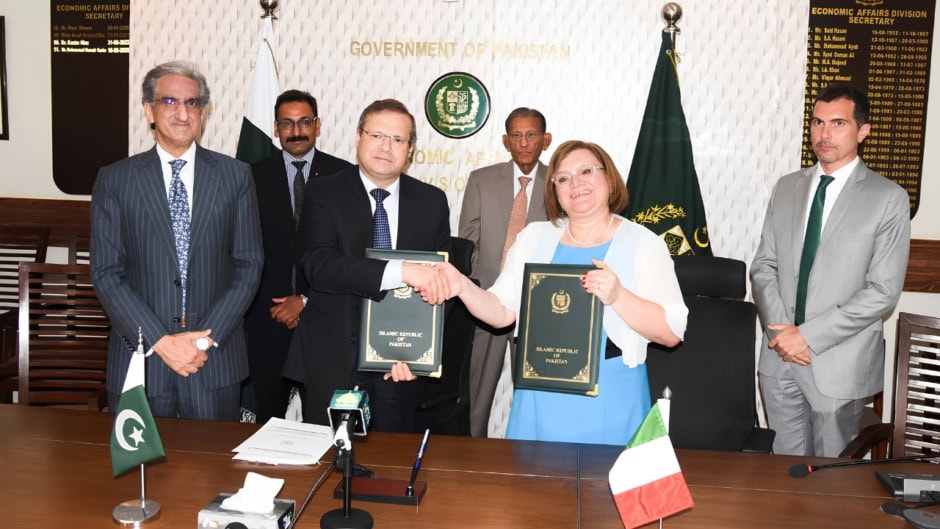
Secretary of the Ministry of Economic Affairs Muhammad Humair Karim represented Pakistan at the signing. Meanwhile, Italian Ambassador H.E. Marilina Armellin represented Italy. Several senior officials from the Italian Agency for Development Cooperation and various provincial departments also attended the event.
Pakistan Takes Loan from Italy to Modernize High-Value Crops
The project aims to strengthen Pakistan’s TVET system. Specifically, it targets the agriculture sector. The initiative will enhance professional skills and improve technical certification. Furthermore, it will promote innovation across agricultural value chains.
Planners designed the project to build the capacity of farmers, extension workers, and trainers. Consequently, these demand-driven training programs will increase productivity and improve livelihoods. The program strongly emphasizes developing high-value crops. These include olives, pistachios, dates, mushrooms, cherries, grapes, peaches, and almonds. Therefore, Pakistan will utilize Italian expertise in modern agronomic practices to scale these specific crops. Dedicated training facilities will also support horticulture processing, marketing, and product diversification.
Infrastructure & Training Targets
Over the next 42 months, the project will roll out 720 training courses. These courses will benefit roughly 18,398 participants, including farmers, women, and youth. Additionally, experts will develop 11 standardized training curricula.
The agreement also includes significant infrastructure investments. Authorities will establish 12 model orchards and nurseries. Furthermore, they will build eight eco-villages equipped with climate-resilient technologies and five agro-food processing units. The government will also launch two National Centres of Excellence. Sargodha, Punjab, will host the center for citrus crops. Turbat, Balochistan, will host the center for date crops.
Implementation & Economic Impact
The Pakistan Oilseed Department will implement the project. They will coordinate directly with Provincial Agriculture Departments to execute the plans. Ultimately, officials expect the initiative to generate rural employment and enhance producer incomes. The project also aims to reduce post-harvest losses, strengthen farmer cooperatives, and improve the overall competitiveness of Pakistan’s agriculture sector.