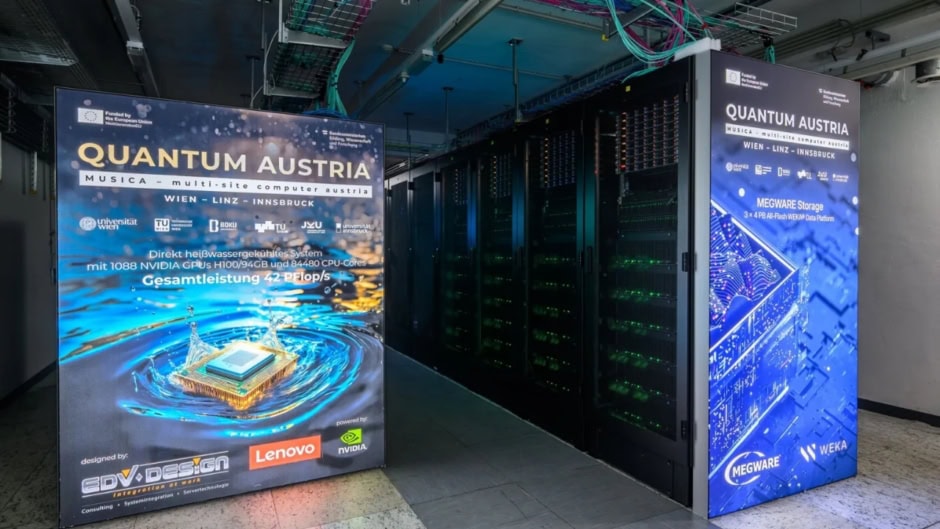
Austria has launched one of the world’s 100 fastest supercomputers. The system carries 1,088 NVIDIA chips and immense computing power. It can perform more than 45,110 trillion calculations per second.
The Multi-Site Computer Austria, or MUSICA, was inaugurated on July 3. It ranks among the top 100 in the global TOP500 list. The system runs on 1,088 high-end NVIDIA H100 GPUs and cloud servers. Those processors are built specifically for data centers and heavy AI workloads.
MUSICA delivers 45.11 petaflops of raw performance. That makes it over eight times more powerful than Austria’s previous systems. It was designed as a general-purpose high-performance computing platform. It supports both traditional science and modern AI applications. The system can train large machine learning models and neural networks. It also runs complex simulations across many scientific fields. Those include physics, chemistry, engineering, and environmental research. A minister called it a milestone for Austria as a research location.
Nikolaus Hautsch, Austrian Scientific Computing (ASC) Steering Committee chair and vice rector for infrastructure at the University of Vienna, said the new system strengthens the country’s research capabilities.
“What is essential now is stable funding for operating costs to ensure that this major investment delivers world-class performance across the entire HPC sector,” Hautsch added.
MUSICA also links to the country’s first production quantum computer. That system is a trapped-ion machine named OTTER. The integration unites AI, quantum computing, and high-performance computing. All three now sit under one national infrastructure.
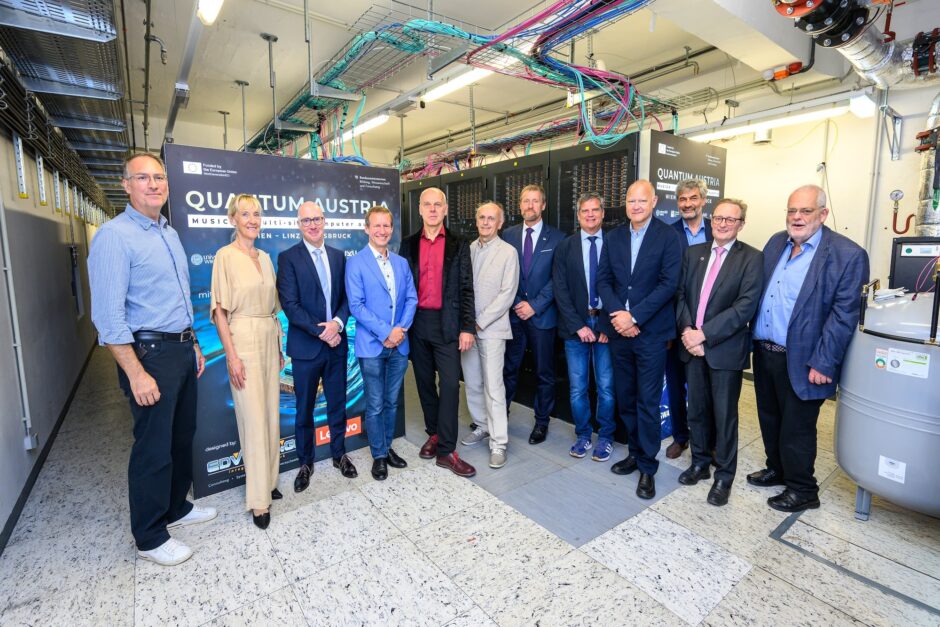
The design is unusual in its physical layout too. MUSICA is spread across three separate Austrian cities. Yet it runs as a single centrally managed supercomputer. If one site fails, the others keep computing without interruption.
Efficiency shaped the engineering as well. Most hardware uses direct hot-water cooling on the chips. That allows free cooling throughout the entire year. It cuts energy use sharply compared with air-cooled systems.
“MUSICA is not only by far the largest supercomputer in Austria. It is a clear commitment by policymakers to Austria as a center of research, a flagship of inter-university collaboration, and an unprecedented driver of data-intensive research and AI development. Its extraordinary computing power enables the next generation of simulations, data analytics, and large neural networks, delivering immediate benefits for the life sciences, environmental sciences, industry, and public institutions,” says Christoph Pfeifer, Vice Rector for Research and Innovation at BOKU University.
The project drew major public funding to reach completion. It received around $23 million through Austrian and EU programs. Universities get free access, while businesses pay per use. Stable operating funds remain the next key challenge.