A physicist at the University of Birmingham built a laboratory “mini universe” that brings scientists closer to answering one of physics’ biggest questions: what is time? The experiment showed that time can emerge naturally from within a quantum system, without relying on any external clock.
Professor Giovanni Barontini demonstrated the finding in a study published in Physical Review Research. Several modern theories suggest time may not be a built-in feature of the universe. The Wheeler-DeWitt equation, for example, describes the cosmos as a single quantum state with no external clock. In that picture, the familiar flow of time must arise from relationships between parts of the system rather than an independent ticking.
To test the idea, Barontini created a simplified quantum universe using a cloud of 24,000 ultracold atoms. He cooled them to a few billionths of a degree above absolute zero. A thin barrier made from two laser beams split the cloud into an observed bright region and an unobserved dark region.
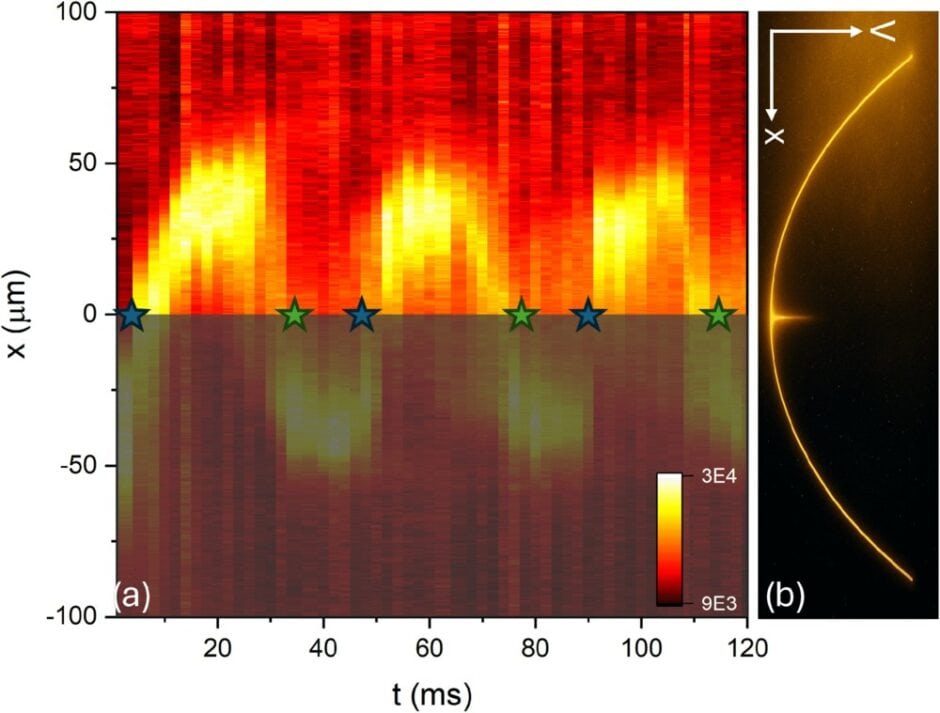
Inside this miniature universe, the bright region repeatedly expanded and contracted. The motion resembled a simplified Big Bang followed by a Big Crunch. Because the system was fully isolated, researchers reconstructed the sequence of events using only information from inside the mini universe.
The results revealed that time arose from changes in entropy, the spread of the atoms between regions. As the particle distribution shifted, the system moved forward in time. When the distribution stopped changing, time effectively halted. Barontini calls this concept entropic time, which flows in one direction and correctly orders events.
The work offers a laboratory platform for testing quantum cosmology and quantum gravity. Scientists could eventually explore the physics of the Big Bang, simulated black holes, and competing theories of how time itself emerges.
See the research for yourself here.