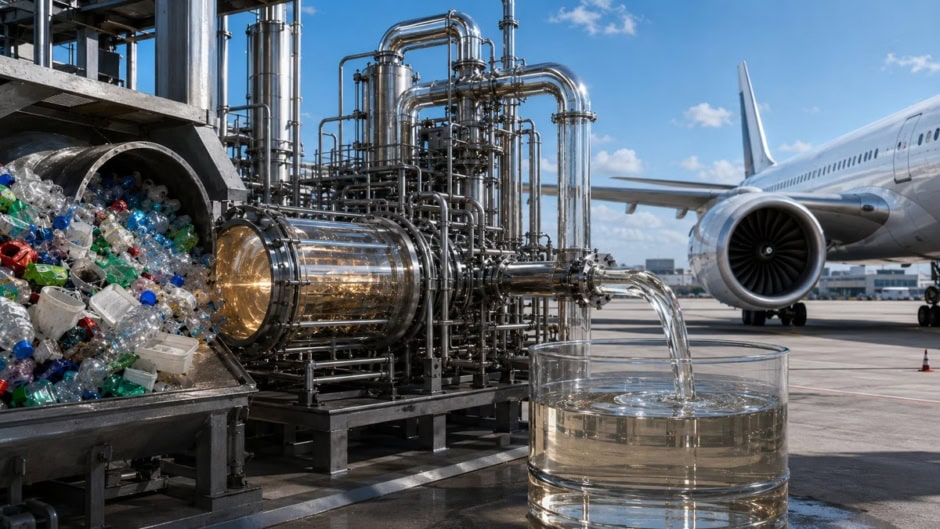
Chinese researchers have developed a new chemical process that could transform waste plastic into valuable jet fuel components at a lower cost, offering a potential solution to the growing global plastic pollution crisis.
A research team from the Shanghai Advanced Research Institute of the Chinese Academy of Sciences and Fudan University has developed a new method based on hydrogenolysis, a chemical process that breaks down long plastic molecules into useful hydrocarbon products.
The technology focuses on polyolefins, including polyethylene and polypropylene, which make up more than 60 percent of global plastic waste. These materials are difficult to degrade because of their strong chemical structure, creating major environmental challenges.
Traditional plastic recycling methods, such as landfill and incineration, often result in pollution and waste of valuable materials. Researchers are exploring ways to convert plastic waste into useful products, including aviation fuel components.
The new process uses a catalyst containing both nickel and cobalt. According to researchers, cobalt improves nickel’s ability to activate hydrogen and break carbon-carbon bonds while reducing excessive breakdown into unwanted gases such as methane.
This allows the process to produce more C8-C16 hydrocarbons, which are important components of jet fuel.
The newly developed catalyst achieved a liquid product yield of 82.3 percent and 79 percent selectivity toward C8-C16 alkanes under relatively mild operating conditions.
The reaction was carried out at 280°C temperature and 3 MPa hydrogen pressure. Unlike earlier methods that depended on expensive noble metals, the use of nickel and cobalt could make the technology more affordable and suitable for future industrial applications.
Researchers found that the process could reduce greenhouse gas emissions by up to 80 percent compared with conventional production methods when powered by renewable energy sources.
The technology could provide a new pathway for recycling difficult plastic waste while supporting cleaner fuel production.
Despite promising results, the technology remains at the laboratory stage. Scientists still need to test whether it can operate efficiently at industrial scale and handle real-world mixed plastic waste.
One major challenge is contamination in waste plastics, as impurities can damage catalysts and reduce their effectiveness. Developing reliable pre-treatment methods will be necessary before large-scale adoption.
Researchers say that if successfully scaled, the technology could help reduce plastic pollution while creating valuable fuel products from waste materials.