
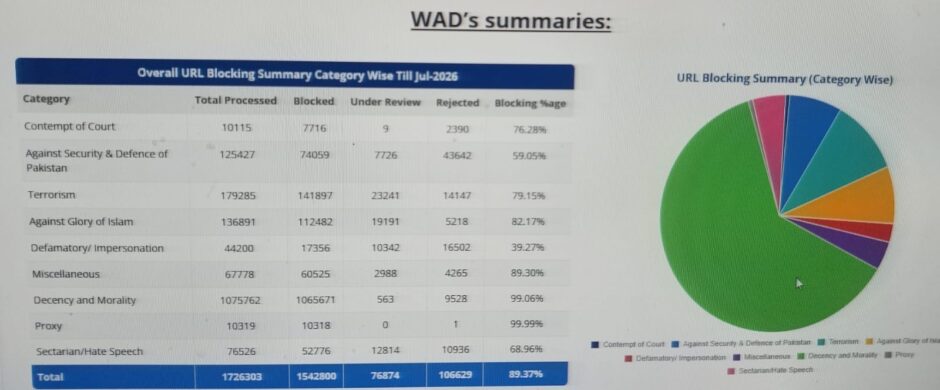
Nearly 69% of all URLs blocked by the Pakistan Telecommunication Authority fall under a single category: “Decency and Morality.” PTA’s Web Analysis Division data shows 1,065,671 URLs blocked under this label out of 1,075,762 processed. That is a 99.06% takedown rate and more than all other categories combined.
PTA blocked over one million morality-related URLs while processing roughly 179,000 terrorism-related complaints. Terrorism blocks totaled 141,897 at a 79.15% rate. “Against Glory of Islam” recorded 112,482 blocks at 82.17%. Content flagged “Against Security & Defence of Pakistan” saw only 74,059 blocks at 59.05%, the lowest blocking rate among major categories.
Sectarian and hate speech content recorded 52,776 blocks at 68.96%. Defamatory and impersonation content had the lowest approval rate at 39.27%, with only 17,356 blocks out of 44,200 processed. Contempt of court accounted for 7,716 blocks at 76.28%.
PTA blocked 10,318 out of 10,319 reported proxy URLs. That 99.99% rate suggests an automated process rather than individual review. Proxy sites exist primarily to bypass PTA’s own blocks, meaning the regulator is spending resources blocking tools designed to circumvent its blocking.
The morality category’s dominance raises fundamental questions about resource allocation. PTA operates a finite workforce and infrastructure. Every hour spent processing morality complaints is an hour not spent addressing terrorism content, hate speech, or national security threats. The data suggests the regulator devotes the overwhelming majority of its capacity to content it considers indecent rather than content that poses direct security risks.
The 99.06% blocking rate under “Decency and Morality” also suggests minimal review. A near-perfect takedown rate across one million URLs implies either automated filtering or a presumption of guilt upon complaint. By comparison, the 59.05% rate for security content and 39.27% for defamation suggest those categories receive more deliberate evaluation.
This data arrives alongside PTA’s recent advisory urging parents to monitor children’s social media activity. Yet the regulator’s own enforcement data shows its primary tool is reactive URL blocking, not proactive platform regulation. PTA processes complaints one at a time. It does not mandate age verification, require platform-level content filters, or enforce algorithmic transparency.
The gap between stated priorities and actual enforcement is now quantifiable. PTA blocks morality content at nearly twice the rate of terrorism content and five times the volume. Whether that ratio reflects Pakistan’s actual digital threats or the regulator’s institutional preferences is a question the data answers clearly.