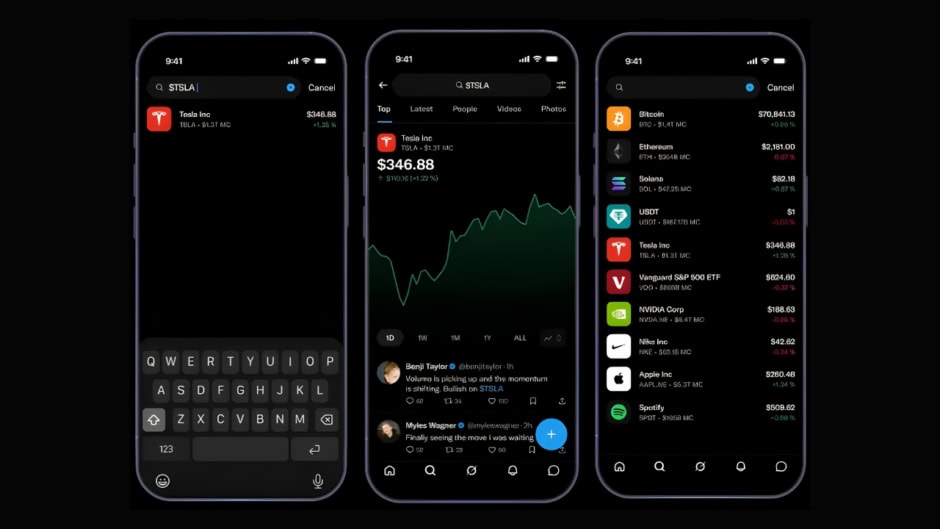
X launched its Cashtag Partner Program on September 16. The platform now connects users directly to trading partners in the United States. Five brokerage partners form the initial rollout. Coinbase, Kraken, and Gemini serve cryptocurrency traders. Interactive Brokers and Moomoo handle traditional stocks and ETFs. Users tap a Cashtag (a dollar-prefixed ticker like $BTC) to access price data and related posts. A new “Trade” button then routes them to their chosen partner platform.
“At launch, X users can tap through Cashtags to brokerage partners, including Interactive Brokers, Moomoo, Gemini, Kraken and Coinbase,” X announced to the world.
The feature expands on smart cashtags X introduced in April. Those cashtags displayed live market data and related discussions. The trading integration turns that information into actionable trading access. X does not execute trades itself. All transactions occur on partner platforms outside X’s infrastructure. Users log into their brokerage accounts through the partner apps or websites.
The Cashtag Partner Program closes the gap between market discussion and market action. X already hosts financial conversations at scale. At the same time, the platform occupies the attention of investors right before they decide to trade. Brokers spend heavily to acquire users at that exact moment. X now captures that intent and directs it to competing brokers. The economics work without X needing to become a regulated brokerage.
A pilot version of Cashtag trading generated approximately $1 billion in global trading volume. That occurred within three days of the initial launch. Mridul Singhai, X’s lead of product engineering, described the goal. Cashtags were designed to close the gap between seeing a ticker and reaching the market. The new program fulfills that original vision at scale.
All in all, the initiative represents another step toward Elon Musk’s “Everything App” vision. X Money already facilitates payments across the United States. Stock and cryptocurrency trading adds financial depth to the platform. The company aims to eventually replace traditional banks as users’ primary financial partner. Whether users will trust X with that responsibility remains uncertain. Security, custody, and regulatory clarity all influence adoption.
Concerns emerged about market manipulation risks. Bots and bad actors could steer conversations around specific tickers to influence retail traders. The reliance on social proof within financial discussions could amplify volatility. Speculation and coordination now carry direct trading consequences. However, these risks exist across financial social platforms, not uniquely to X. The structure keeps X from directly managing accounts or holding assets.