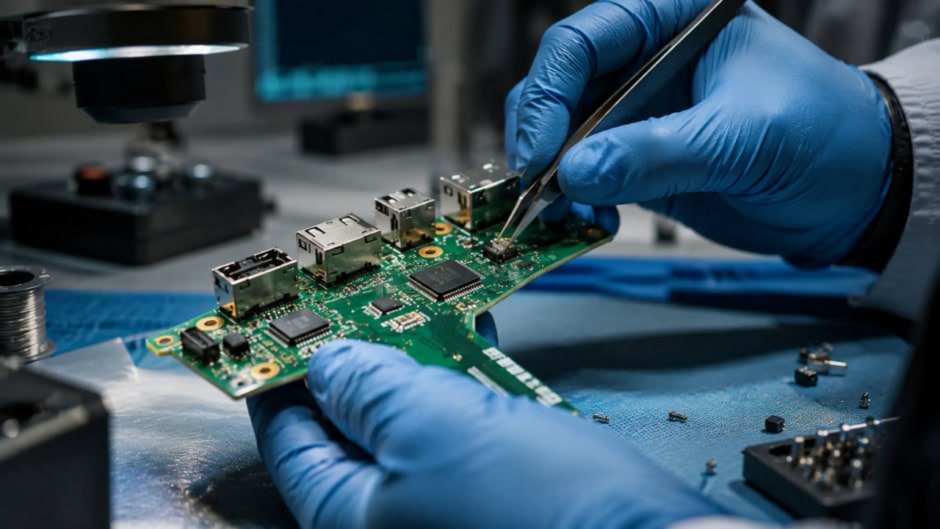
Stanford researchers have built a photonic chip that separates mixed light into clean, distinct beams. The fingernail-sized device could sharpen imaging across cameras, microscopes, and telescopes. It achieves something scientists proposed theoretically decades ago but never managed experimentally. The study appeared on October 30 in the journal Nature Photonics.
The chip targets a fundamental problem in optical imaging. Most natural light arrives partially coherent, meaning its waves only loosely relate to each other. When multiple light sources overlap, their combined intensity hides underlying information. Conventional cameras simply record one blended result and miss the rest.
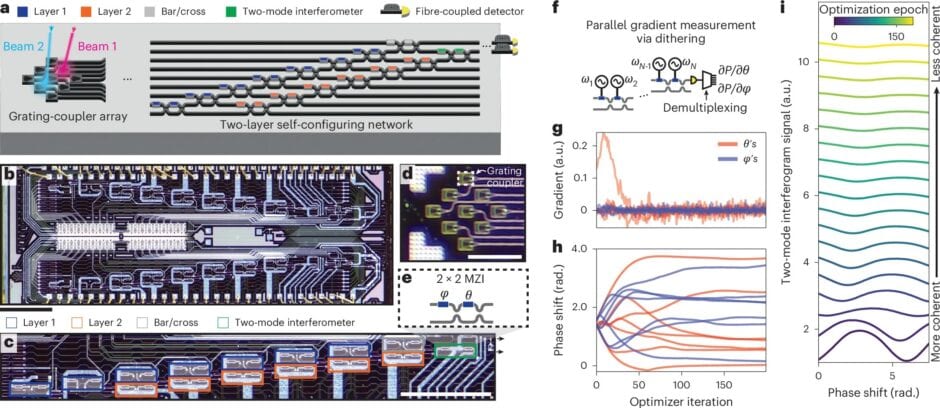
However, that blended light actually contains separable components called coherence modes. Each mode carries different information about the scene being observed. This chip physically extracts and routes those modes into separate output channels. Consequently, imaging systems can access details they would otherwise lose entirely.
“Our chip learns the underlying coherence modes of an unknown light field and physically directs them into separate outputs,” said co-author Shanhui Fan, a professor of electrical engineering at Stanford.
The device uses a silicon photonic circuit packed with tiny interferometers. These optical components guide and manipulate light directly on the chip. An optimization algorithm then teaches the system to identify dominant modes automatically. Once configured, it separates the incoming light without any external processing.
The laboratory results proved impressively accurate in testing. The chip separated two dominant coherence modes with over 98% fidelity. Researchers also verified it works with three modes in a separate experiment. Both results closely matched theoretical predictions from prior work.
The practical applications span several important scientific fields. Under a microscope, two fluorescent particles positioned very close together often blur into one. This chip could reveal they are actually distinct objects entirely. Similarly, a single bright spot in a telescope image might contain light from multiple stars.
NASA is already collaborating with the Stanford team on this possibility. The agency wants to investigate whether the approach can analyze light from distant galaxies. Beyond astronomy, the technology could support optical sensing, communication, and computing.
However, significant development remains before practical deployment arrives. The system needs scaling to handle larger numbers of optical modes. Faster control speeds are also required for real-world imaging applications.
You can read the research paper here.