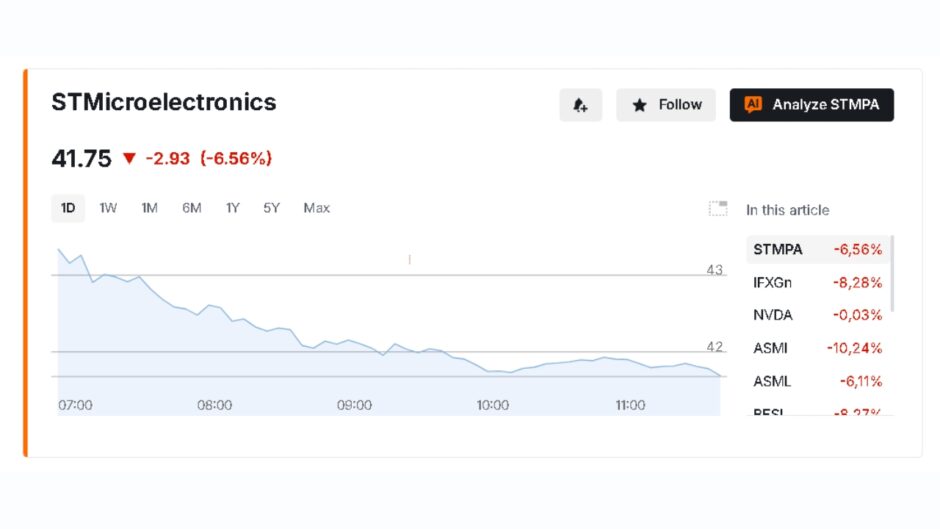
Shares in companies linked to artificial intelligence fell sharply on Monday. The drop followed calls by AI bosses to slow the technology’s development. Notably, investors fear an industry-wide pause could ripple across the sector. Consequently, chipmakers and major AI investors bore the brunt of the sell-off.
The declines began in Asia during overnight trading sessions. South Korean chipmaker SK Hynix ended the day down 6.4%. Meanwhile, Samsung Electronics closed roughly 4% lower alongside it. Together, the two heavyweights dragged the KOSPI index down over 3%.
Japan’s SoftBank suffered an especially steep decline on Monday. The company is a major investor in OpenAI directly. Its shares plunged nearly 11% during Tokyo trading. At one point, they had fallen more than 13% intraday.
The rout dealt a personal blow to SoftBank’s founder too. Masayoshi Son reportedly lost more than $8 billion on Monday. His estimated net worth fell to around $72.5 billion. This starkly illustrated the sell-off’s sheer financial scale.
European markets quickly followed the same downward trend. Germany’s semiconductor firm Infineon dropped around 7.6%. Additionally, Dutch chip giant ASML fell over 5%. ASML manufactures the machines used to produce advanced chips.
US markets also braced for a difficult opening. Nasdaq futures pointed to a drop of roughly 1.8%. In premarket trading, NVIDIA shares slipped over 2%. Rivals Intel and Micron fell around 5% each too.
The underlying investor concern is refreshingly straightforward. A slowdown could reduce large model training projects significantly. It might also extend the intervals between new model releases. Consequently, that could curb demand for GPUs and chips.
The sell-off directly followed a dramatic industry intervention. Anthropic CEO Dario Amodei urged the industry to pace development. OpenAI’s Sam Altman and Elon Musk both backed the call. Notably, Altman also ruled out an OpenAI listing in 2026. These reactions urged Trump to brand AI as the way to move ahead in global competition.
However, analysts urged some caution about the reaction. No company has actually cut its capital spending yet. Similarly, none have reduced their chip orders so far. Therefore, some experts framed the drop as profit-taking. Nonetheless, the episode showed how sharply words now move markets.