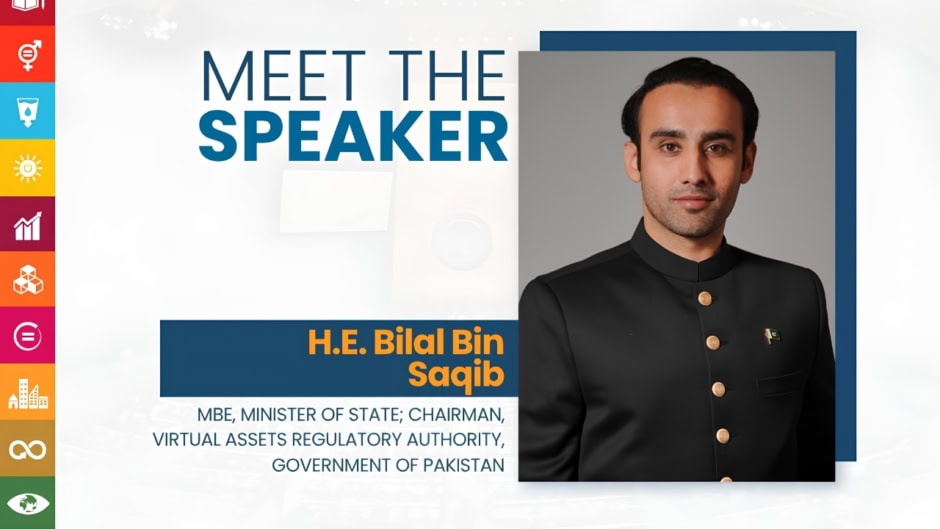
At the 81st UNGA High-Level Side Event, Bilal Bin Saqib delivered a compelling speech. He currently serves as Pakistan’s Minister of State and the Chairman of the Virtual Assets Regulatory Authority. King Charles the Third also honored him with an MBE for his pioneering initiatives. Today, Saqib bridges public policy, youth empowerment, and digital transformation. Ultimately, his address outlined a powerful financial vision for the future.
Lessons from Jobra & the Current Financial Gap
First, Saqib took the audience back to a 1976 story in Jobra. A young economist gave a total of twenty-seven dollars to forty-two women. These women had previously been denied capital from banks. Over time, this historic action proved that small loans work. However, Saqib emphasized a much deeper meaning. For him, the real story is about unmatched courage, tenacity, and resilience.
Transitioning to today, Saqib highlighted a massive systemic gap. Currently, 1.3 billion people still lack access to financial institutions. Ironically, 900 million of those excluded individuals actively use a mobile phone. Essentially, these devices could function as everyday banks. What we lack, however, are proper regulations and rails. For instance, a Gulf worker typically pays a six percent fee to send money home. Consequently, Saqib argued this high cost is a deliberate choice, not a technological limitation.
Harnessing AI & Tokenization for Economic Inclusion
Next, he explored the vital intersection of technology and policy. He noted that neither tool can independently solve these global financial gaps. Artificial intelligence and digital finance are powerful engines for inclusion. Conversely, they can also create tremendous barriers to inequality. Specifically, Saqib pinpointed AI and tokenization as crucial technologies for emerging economies. AI has already read vast amounts of medical, crop, and legal data. Therefore, it can partner with professionals to overcome missing legacy infrastructure. Meanwhile, tokenization allows instant settlement via stablecoins. This ultimately offers investors financial freedom through smaller ticket sizes.
Moreover, Saqib stated the Global South is no longer just on the menu. Instead, they now have a firm seat at the table. For example, Pakistan has drastically shifted its approach to digital finance. Since 2018, the state had banned institutions from interacting with digital assets. Fortunately, Pakistan changed that complete ban within a year. Now, the nation explores how virtual assets can connect local enterprises to international capital pools. Clearly, the Global South possesses the population and possibilities to lead.
Bilal Bin Saqib Gives Powerful Call to Action for the Youth at UNGA
Finally, Saqib delivered a striking message to the youth. He warned that being called “leaders of tomorrow” simply means waiting your turn. Instead, he urged them to be bold and delusional. He reminded them that zero poverty and zero unemployment were just mission statements recently. Today, however, the economics of building have completely changed. Now, anyone with a phone has the tools to solve existing problems. This truly is the age of possibilities.
Here is what Bilal Bin Saqib had to say after his speech:
Honoured to speak today at the 81st UN General Assembly High-Level Event on Social Business, Youth and Technology at the United Nations Headquarters in New York.
My journey began in social enterprise, working to address Pakistan’s water crisis. Today, in public service, I am… pic.twitter.com/CX8U1Htns1
— Bilal bin Saqib MBE (@Bilalbinsaqib) September 21, 2026