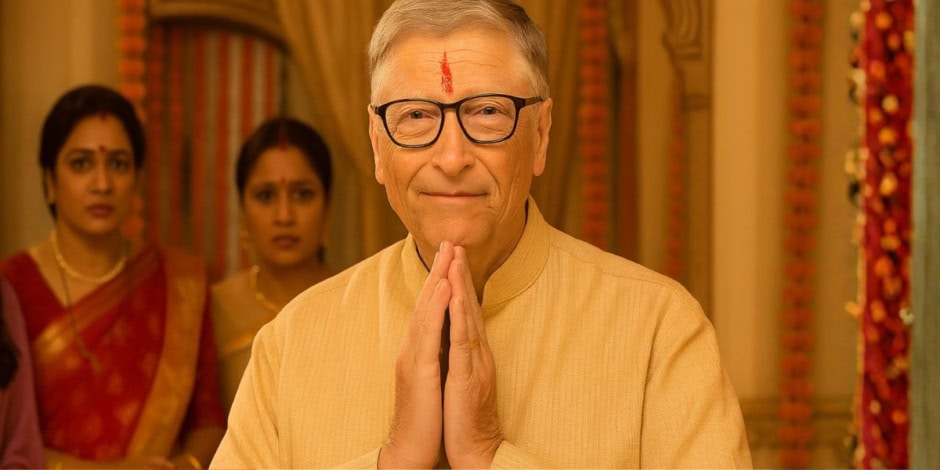
The recent announcement of Bill Gates’ guest appearance on the rebooted Indian soap opera Kyunki Saas Bhi Kabhi Bahu Thi 2 has generated buzz on the social media. More in the Indian netsphere than anywhere else, for obvious reasons. However, this marketing gimmick also invites scrutiny when juxtaposed against Microsoft’s decision to shutter its direct operations in Pakistan after 25 years.
While the cameo is framed as a lighthearted cultural crossover promoting health awareness, the timing and contrast highlight inconsistencies in global tech giants’ regional strategies, raising questions about selective engagement, economic priorities, and performative philanthropy.
A Celebrity Moment With Strategic Layers
In the promo, Gates appears via video call with the character Tulsi Virani (played by Smriti Irani), greeting her in Hindi with “Jai Shri Krishna” while she thanks him for keeping up with her family. Cut to the episode, his appearance on the show broadly discussed maternal and newborn health, aligning with his foundation’s initiatives.
The episodes aired starting October 23, 2025, on Star Plus and streamed on JioHotstar, tapping into the show’s massive nostalgic appeal from its original run (2000–2008), which drew peak viewership of over 20 million. On the surface, it’s a novel way to reach India’s vast audience, where soap operas like this remain a staple for family viewing and social messaging.
To the untrained eye, this might just seem like a marketing stunt. However, it’s a calculated PR move. India represents a booming market for Microsoft, with over 1.4 billion people, robust digital infrastructure growth, and government-backed initiatives like Digital India.
Gates’ foundation has invested heavily there in health and agriculture programs. By embedding in popular culture, Gates amplifies brand visibility among non-tech demographics, potentially boosting adoption of Microsoft tools and foundation causes. Yet, critics argue this risks trivializing serious issue, reducing global health advocacy to a scripted soap scene, which could undermine credibility if viewers see it as mere celebrity endorsement rather than genuine outreach.
Microsoft’s Pakistani Exit in the Backdrop
In stark contrast, Microsoft announced in July 2025 that it was closing its Pakistan operations, established in 2000, as part of a “global restructuring” to transition to a “partner-led, cloud-based model.”
This affects a small local team, with customer support shifting to third-party partners abroad. While the company insists it’s not a full withdrawal, maintaining services through partners, the move signals a deprioritization of direct investment in a market of nearly 240 million people.
Analysts point to factors like economic instability, regulatory hurdles, and lower growth potential compared to neighbors like India, where Microsoft has expanded engineering hubs. Pakistan’s tech sector, while growing, faces challenges including power outages, talent retention, and geopolitical tensions, which may have contributed to the decision.
What makes this jarring is the optics: as Gates leverages Indian pop culture for positive branding, his former company retreats from a neighboring South Asian market, potentially exacerbating local job losses and signaling to investors that Pakistan is a riskier bet.
What’s Really Going On?
1. Strategic Narrative Control: Gates’ cameo may be part of a pattern where philanthropists use media to humanize their image. Past appearances on shows like The Big Bang Theory and Silicon Valley show Gates’ comfort with scripted roles.
In India, this aligns with Microsoft’s aggressive push into AI and cloud services. But critiquing this, it feels like narrative deflection, focusing on feel-good stories while corporate arms make pragmatic cuts elsewhere, avoiding accountability for uneven global commitments.
2. Regional Investment Signalling: Microsoft’s exit underscores a triage approach: prioritizing stable, high-growth markets like India (with GDP growth projected at 6-7% annually) over Pakistan (grappling with inflation above 20% and IMF bailouts). We also see other tech firms scaling back in phases. However, it begs to attention a broader issue of “digital colonialism,” where multinationals extract value without long-term investment, leaving local ecosystems vulnerable and widening the regional tech divide.
3. Branding vs. Business: Gates’ philanthropy often overlaps with Microsoft interests, but here the disconnect is palpable. While the foundation claims global equity, the business exit implies profit-driven selectivity. But doesn’t it erode trust: Why champion health in one country via TV while pulling resources from another facing similar challenges, like Pakistan’s maternal mortality rates (comparable to India’s in underserved areas)?
The Critique: Is the Messaging Coherent?
Here is the catch: Inserting a Western billionaire into a quintessentially Indian family drama could come off as tone-deaf tokenism. To some, it may seem harmless fun, to others, it looks pure dilution of the show’s authenticity and reinforcing stereotypes of elite outsiders “saving” the Global South.
Bill Gates’ Kyunki Saas Bhi Kabhi Bahu Thi 2 appearance is clever marketing, however gimmicky. Pairing it with Microsoft’s Pakistan pullout, it underscores a troubling selectivity in where tech titans invest their capital.
Some might even suggest it speaks starkly about global inequalities, where markets are ranked by profitability rather than need. Stakeholders should demand more coherence: If philanthropy is truly global, why the regional cherry-picking? Ultimately, such contrasts reveal that for entities like Microsoft and the Gates Foundation, engagement is strategic, not equitable, and that’s a narrative worth critiquing beyond the screen.