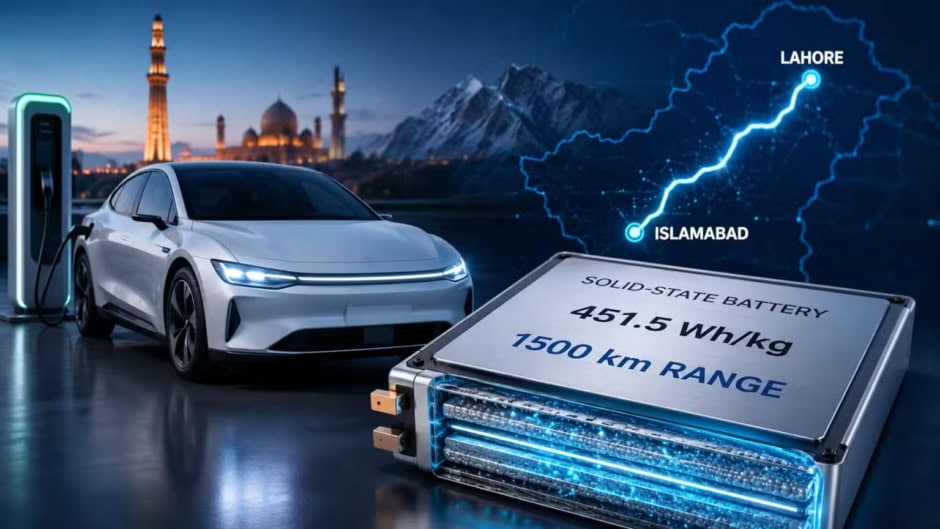
Chinese researchers have developed a new solid-state lithium-metal battery that could significantly extend electric vehicle driving range, with estimates suggesting up to 1,000–1,500 kilometers on a single charge.
The development comes from scientists at the Chinese Academy of Sciences’ Institute of Metal Research, where the team engineered a battery achieving an energy density of 451.5 Wh/kg. This marks a major improvement over conventional lithium iron phosphate (LFP) batteries, which typically operate around 200 Wh/kg.
The breakthrough technology could allow electric vehicles to complete multiple long-distance trips such as the Lahore to Islamabad Motorway route (around 370 km) up to four times without recharging.
Researchers also highlighted ultra-fast charging capability, with charge and discharge cycles occurring in roughly three minutes under high-rate testing conditions. The battery maintained stable performance even at a 20C charge rate and retained about 81.9% capacity after 700 cycles.
A key innovation behind the development is a “compatibilizing-solvent plasticization” method used in PVDF-based polymer electrolytes. This process improves material compatibility during manufacturing before stabilizing the structure once the solvent evaporates.
In prototype testing, the team successfully built an ampere-hour-scale pouch cell using a thin lithium-metal anode. The cell also passed safety tests, including nail penetration resistance, while maintaining structural integrity.
While the technology shows strong potential, experts note that lithium iron phosphate batteries still dominate the current electric vehicle market, with companies continuing to scale production while solid-state systems move through pilot and validation stages.
Industry players such as CATL, BYD, Ganfeng Lithium, Sunwoda, and Farasis Energy are all reportedly advancing their own next-generation battery programs, with broader commercialization expected in the coming years.