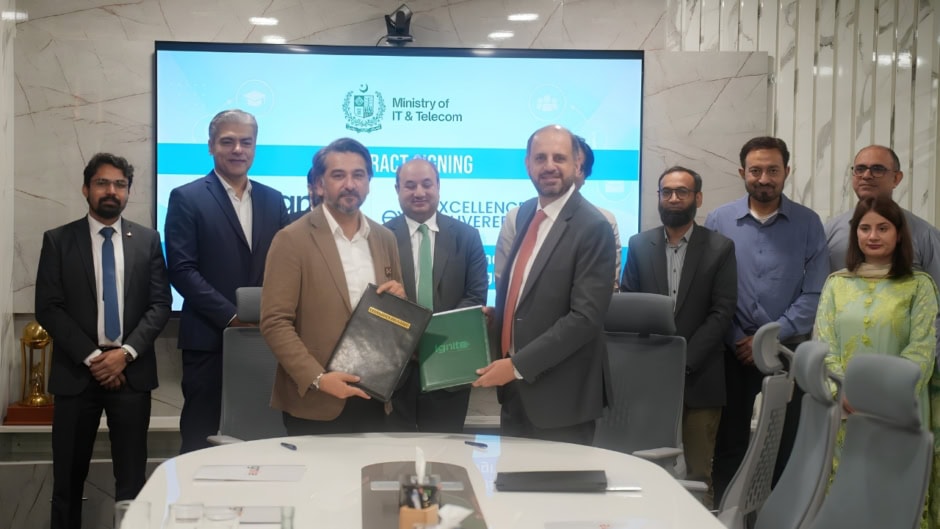
On October 7, 2026, Ignite – National Technology Fund signed a major contract with Excellence Delivered (ExD). The goal behind this ExD-Ignite deal sounds fantastic on paper. The program will train 2,500 Pakistani youth in internationally recognized SAP certifications. Furthermore, it promises soft skills and language training to create an “export-ready” workforce.
At first glance, this looks like a massive win for Pakistan’s IT sector. However, a deeper look reveals a troubling timeline. ExD’s founder and Chairman, Sajjad Mustafa Syed, just finished a highly controversial term as the Chairman of P@SHA. Only months ago, he actively lobbied the government to squeeze independent freelancers. Today, his company is securing lucrative government funds.
This dynamic raises a critical question. Is the line between corporate lobbying and state procurement in Pakistan fundamentally broken?
The Freelancer Tax Flashback & The Bidding Overlap
Let’s rewind to May 2026. Back then, Sajjad Syed led P@SHA. Under his leadership, the IT association heavily lobbied the government. They specifically targeted independent tech workers. P@SHA demanded the elimination of a 0.25% Final Tax Rate “loophole” utilized by remote workers and freelancers.
P@SHA argued that this tax structure caused a severe “brain drain”. They claimed local software houses could not financially compete with foreign companies hiring remote Pakistani talent. Consequently, this proposal triggered massive public outrage. Independent workers felt penalized. They accused P@SHA of trying to crush the freelance economy simply to protect the profit margins of large, local IT firms.
Fast forward to October 8, 2026. ExD has officially secured a massive deal with Ignite. Ignite operates directly under the Ministry of IT and Telecommunication (MoITT).
Here is the structural catch. Government procurement cycles are famously slow. RFPs, bidding, vetting, and final approvals take months. Therefore, ExD almost certainly negotiated and bid on this massive project right in the middle of Sajjad Syed’s tenure as P@SHA Chairman.
Furthermore, he was actively lobbying the MoITT and the FBR on tax policy during this exact same window. This timeline creates a glaring conflict of interest. It paints a picture of an elite corporate tier using its lobbying power to suppress independent competition while simultaneously utilizing state funds to subsidize its own business.
Credit Where Credit is Due: The ExD-Ignite Deal
To maintain journalistic integrity, we must look at the facts regarding the vendor. Excellence Delivered is not a fly-by-night shell company created to siphon Ignite funds. Founded in 2010, the firm is an established SAP Platinum Partner. Sajjad Syed himself served as the Managing Director of SAP Pakistan before founding ExD.
Without a doubt, ExD possesses the technical pedigree to execute this training program. They have successfully delivered major digital transformation projects for the SECP, SNGPL, and various ministries for 15 years.
Therefore, the issue here is not competency. Instead, the issue is strict governance and optics. The story is not that ExD cannot do the job. The real story is that the boundary between P@SHA’s lobbying arm and MoITT’s procurement arm has completely blurred.
The Need for Democratization
Pakistan’s IT sector desperately needs structural guardrails. When industry leaders mix private business interests with public lobbying, the entire ecosystem suffers.
Mature tech industries prevent these scenarios easily. They implement mandatory recusals and enforce strict “cooling-off” periods for active board members. They build transparent, blind walls around state procurement. Right now, MoITT, Ignite, and P@SHA clearly lack these basic ethical protections.
Thankfully, P@SHA recently stabilized after a chaotic summer. Following a messy no-confidence vote and a subsequent reinstatement by the Directorate General of Trade Organisations (DGTO) in August, the association finally transitioned into its scheduled election cycle. Today, Dr. Shoab Ahmed Khan leads P@SHA.
This new leadership has a critical task ahead. They must democratize the industry. Pakistan cannot afford a tech sector where only corporate elites win. We need policies that protect independent freelancers, support local software houses, and ensure absolute transparency in government bidding.
Until we build clear boundaries between lobbying and state procurement, public trust will remain broken.