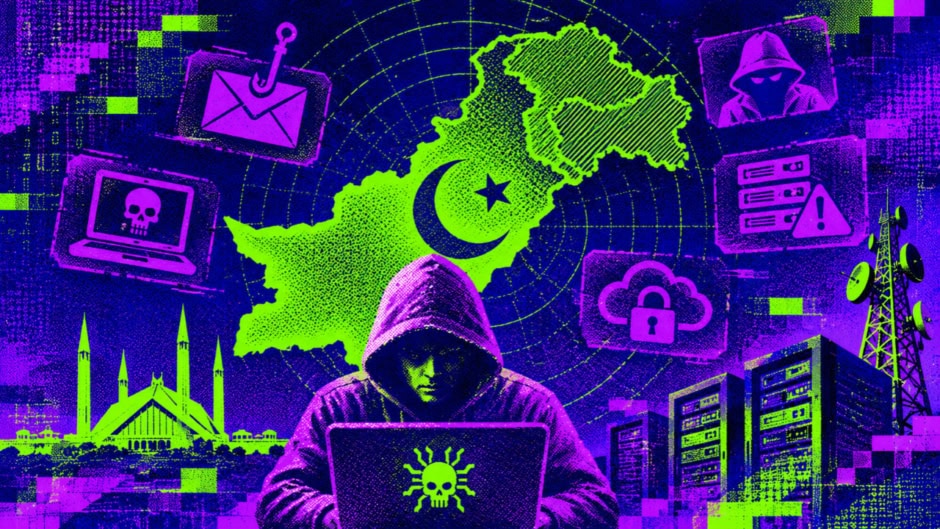
Pakistan’s 167 million internet users face five distinct cyber threats simultaneously in late 2026. They range from nuclear espionage to mass credential theft.
However, their real-world impact varies enormously. Here is what each threat actually means, verified against the sources that documented them.
Nuclear Espionage: Critical but Narrow
The most alarming discovery surfaced on November 1. Security researchers at InfraHunter found an exposed server hosting a full intrusion toolkit. They linked it to APT-C-35, also known as DoNot or Viceroy Tiger. This group has long been attributed to Indian state sponsorship.
Brinztech independently corroborated the findings the following day. The tools specifically name PAEC, KANUPP, OGDCL, and Chashma as targets through hardcoded references. Additionally, the toolkit includes credential-harvesting tools, custom reverse shells, and SCADA reconnaissance scripts. This targeting aligns with DoNot’s documented history of attacking South Asian defense organizations.
However, the reach is extremely narrow, likely numbering in the hundreds of potential targets. For ordinary internet users, this threat is invisible. For the specific employees it targets, though, the national security implications are severe.
Spyware Ads: Massive Exposure, Now Offline
The broadest exposure came through spyware-laced advertisements. Citizen Lab published its landmark “Exposing AdFection” report on October 15, documenting the full campaign. An Israeli firm called Discover-Tech used online ads to deliver Candiru spyware to targeted devices. Pakistan ranked second globally with approximately 139 million malicious ad bids between March and June 2026. Only Yemen ranked higher at 457 million.
The ads appeared on popular Pakistani sites including WhatMobile, and even on government-operated networks. Notably, Citizen Lab identified a user called “Pindi” who accessed the platform exclusively from Pakistan. However, the 139 million figure represents ad bids, not confirmed infections. Citizen Lab explicitly states that an ad impression alone does not confirm targeting.
Furthermore, Discover-Tech shut down its platforms in August 2026, and Google removed it from ad exchanges in October. Consequently, this specific delivery channel is now closed, though devices infected during that window may still carry spyware.
Stolen Credentials: The Biggest Everyday Risk
The most practically dangerous threat involves stolen logins.
Roughly 760,000 Pakistan-linked credentials appeared in infostealer logs during 2026. According to ThreatMon, 57.6% tied to .gov.pk domains including FBR, Punjab government, and NADRA portals. These came from infected personal devices, not direct government breaches.
Nevertheless, each stolen login gives attackers ready access to sensitive systems. A single NADRA session cookie enables identity theft at scale.
Ransomware Hitting Healthcare Hardest
ThreatMon confirmed seven ransomware incidents with Pakistani victims during 2026. Healthcare suffered three of those attacks, making it the hardest-hit sector by far. Groups including Qilin, DragonForce, NightSpire, The Gentlemen, and APT73 all claimed Pakistani targets.
These attacks typically combine data encryption with theft and double-extortion demands. Attackers lock systems first, then threaten to publish stolen data unless a ransom is paid. Each incident carries outsized impact regardless of the low overall count. A single hospital locked out of its systems endangers patients directly.
Earlier this year, TechJuice reported that one government body suffered a ransomware attack forcing full data restoration from backups. However, seven confirmed incidents likely understates the real picture considerably. Pakistan has minimal breach-disclosure requirements, so many attacks never reach public reporting.
Website Defacements and Data Leaks
National CERT recorded over 1,000 cyberattacks across 2024 to 2026. Separately, PTA’s dark-web monitoring between July 2025 and June 2026 flagged 326 significant threat indicators. Of those, 53% involved website defacements while 27% represented data leaks.
Government and university websites remain the most frequent targets across both datasets. These attacks spike predictably around national days like August 14 and September 6. They primarily damage institutional web presence rather than harming individual users directly.
However, data leaks carry downstream consequences that affect real people. Personal information exposed through a university breach can fuel phishing, fraud, and identity theft for months afterward. The volume of attacks also strains an already thin defensive layer. National CERT currently operates with roughly 70 staff members across the entire country.
A Thin Line of Defense
Defending against all five threats simultaneously, National CERT relies on AI for approximately 30% of its monitoring workload. Meanwhile, PTA has flagged emerging risks to Pakistan’s upcoming 5G networks, including subscriber data theft and core network attacks.
For Pakistan’s digital infrastructure, the pressure is sustained, multi-directional, and growing faster than the resources meant to contain it.