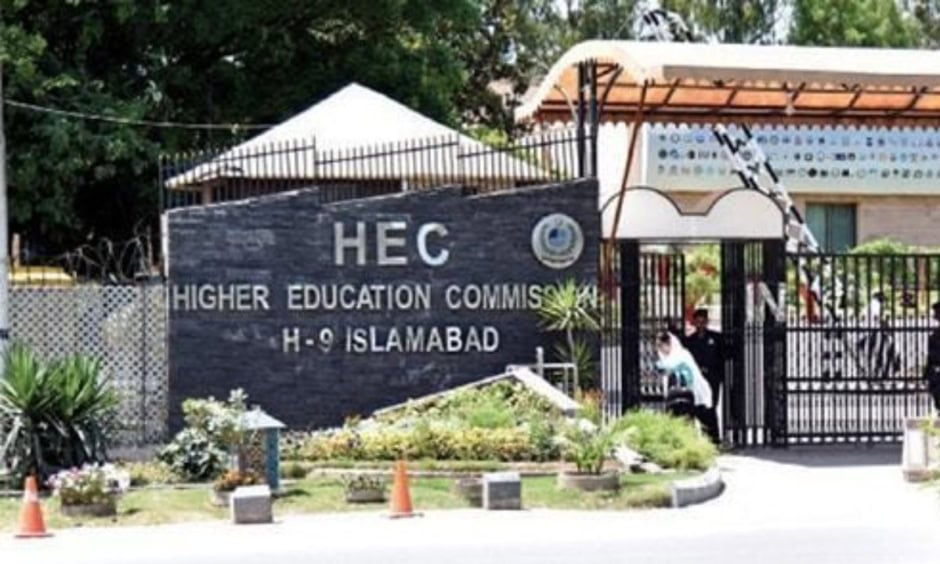
The Higher Education Commission (HEC) Pakistan is undertaking comprehensive reforms and policy interventions aimed at strengthening governance, while putting strenuous efforts to accelerate digital transformation and internationalisation of higher education.
This was stated by Chairman HEC Dr. Niaz Ahmad Akhtar while addressing a press briefing here at the Commission Secretariat on Wednesday. He termed the media a very important stakeholder of development in the higher education sector and presented an overview of the developments that have taken place during the last few months.
Dr. Niaz Ahmad Akhtar said, “HEC’s foremost priority has been the strengthening of governance.” He maintained that HEC engaged all the relevant stakeholders, holding meetings of the Commission, Vice Chancellors Committee, Accreditation Councils, and other decision-making forums. He said that coordination with provincial HECs and higher education departments has also been enhanced to ensure uniform and effective implementation of policies nationwide. He also shared the outcomes of his recent extensive visits across universities from Karachi to Gilgit-Baltistan, saying that the visits provided direct insights into institutional challenges, governance models, student needs, and regional educational strengths.
Referring to digital transformation initiatives, the Chairman termed the launch of online attestation services a major public facilitation reform that would reduce unnecessary travel, delays, and inconvenience for students and graduates. HEC has achieved a milestone in the public service delivery by adopting an entirely paperless, online degree attestation system.
Apprising the media of HEC’s efforts to revitalise accreditation councils, he said that HEC is working on establishing new accreditation councils in disciplines including Natural Sciences, Social Sciences, Biological Sciences, Languages, and Psychology.
He said that HEC has established task forces on different key academic matters, including a task force to recommend on how the position of Pakistani universities can be strengthened in the international rankings. He underlined that in 2026, 18 Pakistani universities have made their way into QS Ranking and 48 universities in the Times Higher Education Ranking, which is a sharp growth as compared to six in QS Ranking and only two in Times Higher Education in 2016.
He also highlighted HEC’s efforts to strengthen National Centres of Excellence. He underscored that HEC has also set up National Chairs on different emerging areas, including Artificial Intelligence, Robotics, Automation, Data Science, Cyber Security and Cloud Computing. “The National Chairs, comprising experts from 10-12 institutions with a lead university, will serve as premier platforms for policy direction, strategic alignment, governance frameworks, and comprehensive assessment of Pakistan’s ecosystem requirements,” he said.
On HEC’s internationalisation endeavours, Dr. Akhtar informed that policy on Dual, Double and Joint degree programme has been introduced to facilitate collaboration between local and international universities. The policy, he added, will benefit students by expanding access to international learning opportunities, credit mobility, joint supervision, global academic exposure and improved employability. He also highlighted HEC’s academic engagement with different friendly countries to materialise international collaborations and partnerships.
The Chairman HEC stated that third-party testing for admissions into MS/MPhil and PhD programmes has been made mandatory through HEC’s Education Testing Council (ETC) to promote transparency, standardisation, and merit-based admissions in line with international practices. This centralised testing mechanism is aimed at ensuring quality assurance, transparency, standardisation, and merit-based admissions across graduate education in Pakistan, thereby establishing a uniform and credible national-level assessment framework.
Dr. Akhtar said HEC had recently conducted nationwide National Skill Competency Test (NSCT) for IT graduates to assess the quality of graduates being produced by universities. He informed that 33,000 students of 199 universities appeared in the test held at 162 test centres across 116 cities of the country. The results, he said, are helping universities improve curricula, teaching systems, and alignment with market and industry requirements.
Sharing progress regarding degrees of students availed from illegal institutions, Dr. Akhtar informed that approximately 56,000 pending degree cases and 126 pending PhD cases have been resolved during the past few months.
To encourage talented youth, the Chairmans said HEC has revived the national-level Talent Hunt Programme for students from O-Level, A-Level, and FSc. backgrounds. Outstanding students are being enabled to represent Pakistan in International Science Olympiads, he added. He noted that Pakistani students have already demonstrated remarkable performance in such competitions.
Concluding the briefing, the Chairman said that although considerable room for improvement still exists, HEC has laid a strong foundation for reform, transparency, digitalisation, international collaboration, and academic excellence. He reaffirmed the Commission’s commitment to steering Pakistan’s higher education sector towards greater effectiveness, competitiveness, and global relevance.