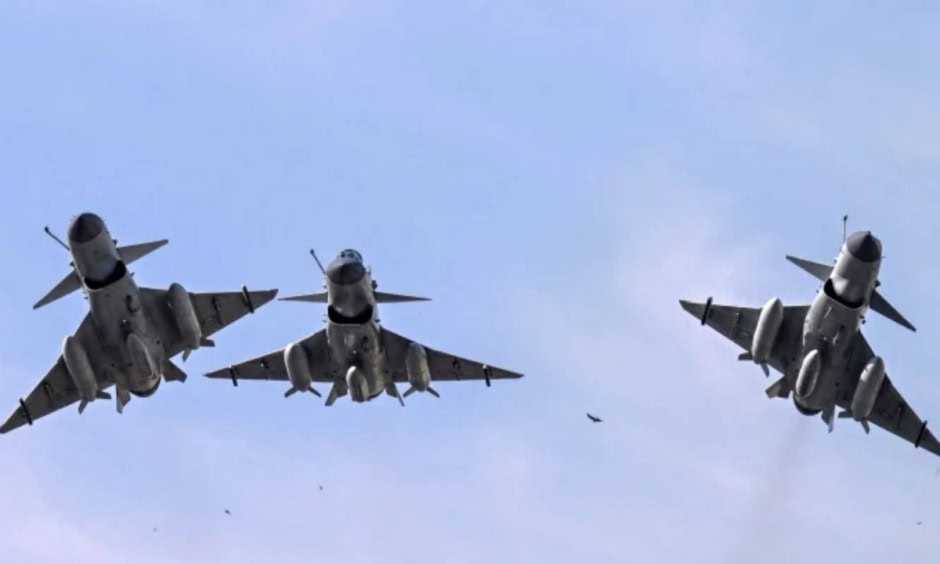
The state-owned AVIC Chengdu Aircraft Corporation in China has recorded its highest-ever annual revenue, following the combat debut of its J-10C fighter jet in South Asia.
The Chinese aerospace manufacturer reported total revenue of 75.4 billion yuan, equivalent to approximately 11 billion US dollars, marking a 15.8 percent increase over the previous year.
Net profit rose by 6.5 percent to reach 3.4 billion yuan for the full year 2025, according to a company statement cited by Bloomberg financial news agency.
First-quarter sales for 2025 surged by nearly 80 percent compared to the same period last year, reflecting sharp growth momentum in Chinese military aviation manufacturing.
Pakistan’s Induction of the J-10C
Pakistan Air Force formally inducted the J-10C fighter aircraft into its fleet in March 2022, significantly strengthening its aerial combat capabilities and national airspace defence posture.
The aircraft was described at induction as capable of carrying advanced fourth-generation air-to-air missiles, including the short-range PL-10 and the beyond-visual-range PL-15 missile systems.
The May 2025 Conflict
The J-10C entered combat for the first time in May 2025, when Pakistani forces responded to an Indian military operation launched on the sixth of that month.
The Indian military action followed an attack on tourists in Indian-administered Jammu and Kashmir, which New Delhi used as the basis for initiating strikes against Pakistani territory.
Over 87 hours of active conflict, Pakistani forces reportedly downed seven Indian fighter jets, among them French-manufactured Rafale aircraft, along with dozens of unmanned aerial vehicles.
Chinese Weapons Systems in Action
Pakistan deployed several Chinese-made platforms during the four-day war, including the HQ-9 air-defence system, PL-15 air-to-air missiles, and the J-10C multi-role combat aircraft.
Pakistan JF-17 Thunder jets, armed with hypersonic missiles, were also used to strike and destroy India’s Russian-made S-400 air defence installation located at Adampur air base.
The conflict concluded on May 10, 2025, when both nations agreed to a ceasefire brokered through diplomatic intervention by the United States government.
International Assessments
ISPR Director-General Lieutenant General Ahmed Sharif Chaudhry publicly praised Chinese weapons in October 2025, saying they had performed exceptionally well in combat.
In November 2025, a formal report submitted to the United States Congress acknowledged what it described as Pakistan’s military success over India during the four-day confrontation.
The US-China Economic and Security Review Commission stated in its report that Pakistan had employed advanced Chinese military weaponry to establish a battlefield advantage over Indian forces.