
Meta is expanding its test restricting link posts on Facebook business Pages, requiring paid subscriptions to exceed monthly limits. Managers across multiple accounts reported receiving notifications indicating their Pages are now limited to two posts with external links per month. Unlimited link posting requires a Meta One for Business subscription.
The restriction represents an escalation of Meta’s monetization strategy for business users. The company originally introduced the test in December 2025 on a limited basis. However, the September launch of Meta One for Business subscription packages appears to have triggered broader expansion of the limit across more Pages.
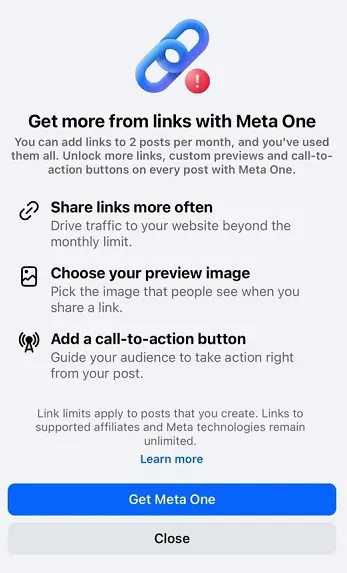
Meta One for Business includes tiered link-post allowances varying by subscription level. Instagram and Reels already feature link limits as part of the paid package benefits. Facebook link restrictions were not initially listed as a Meta One benefit, but the emerging limitations suggest the company is now applying the same logic across its ecosystem.
Meta previously stated the restriction was designed to evaluate “whether the ability to publish an increased volume of posts with links adds additional value” for paying users. Publisher Pages remain exempt from the test, allowing news organizations to continue unrestricted external linking.
The timing feels deliberately configured to pressure business users toward subscriptions. However, the restriction’s actual impact may be limited because link posts receive minimal organic reach on Facebook. Meta’s Q1 2026 Widely Viewed Content report found that only 1.3% of widely viewed posts included external links to sources outside Facebook. This represents a dramatic decline from 9.8% in 2022, when Meta first started tracking the metric.
The pattern reflects Meta’s three-stage monetization strategy outlined by CEO Mark Zuckerberg in 2016: first build a product people love, second facilitate organic business behavior free of charge, third create paid avenues for businesses seeking expanded reach. While the approach feels like a bait-and-switch tactic, it remains consistent with Meta’s established practice.
Many business managers view the restriction as aggressive monetization of content that Meta ultimately benefits from through platform engagement. However, because link posts already struggle to gain visibility, forcing users to pay for increased volume may not significantly impact business performance or engagement metrics.