Meta says it has largely caught up with the biggest AI labs. The company made this claim while releasing Muse Spark 1.3, its most powerful large language model so far. Developers can now access the model through Meta’s API for a fee. Additionally, it will roll out to Facebook, Instagram, and the Meta AI app in the coming days.
Meta Chief AI Officer Alexandr Wang framed the release as a major leap. He told Bloomberg that Muse Spark 1.3 represents the company’s biggest jump in model performance yet. According to Wang, this puts Meta on par with recent models from OpenAI and Anthropic. He specifically called it “competitive” with Claude Fable 5.1. He also claimed it performs “better than” OpenAI’s GPT-5.6 Sol, especially at generating code.
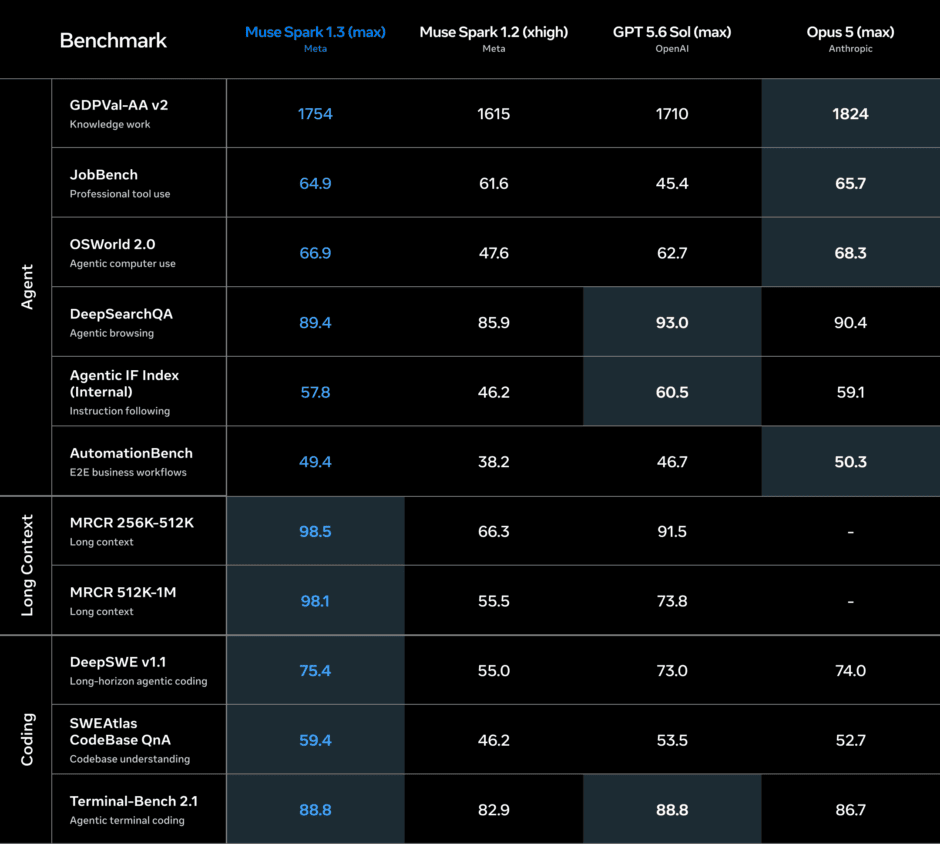
Such claims are always difficult to verify independently. Companies can easily game the benchmark tests they publish. However, an independent analysis by Artificial Analysis offered some support. Muse Spark scored 62 on its Intelligence Index. That placed it behind only Fable 5.1 and Opus 5, while ranking ahead of OpenAI’s models.
As Meta puts it:
Muse Spark 1.3 is designed to better sustain longer-horizon work by collaborating with users and juggling multiple workflows in a single, long thread. When given an open-ended objective, it uses tools to generate its own context across messy and conflicting sources, proactively corrects gaps in its plan, and keeps track of what it has learned to produce a final deliverable. We trained the model across a diverse set of harnesses to generalize to various agentic environments.
The evaluation suggests Meta’s massive AI spending may finally deliver returns. The company has invested hundreds of billions of dollars in AI infrastructure. Last year, Mark Zuckerberg revamped Meta’s AI strategy entirely. He paid over $14 billion to acquire a stake in Wang’s former company, ScaleAI. However, this heavy spending has drawn scrutiny from nervous investors.
“Muse Spark 1.3 was trained on more long-horizon coding tasks and shows improved usability in common engineering workflows,” Meta said. “Relative to Muse Spark 1.2, it takes fewer turns where not needed and is less verbose, while having a cleaner overall coding style. In comparisons by Meta engineers, it proved to be significantly faster and more efficient, using ~20% fewer tool calls and ~25% fewer tokens.”
The model has more awareness of its own limitations. Notably, it asks for confirmation before taking any irreversible action. Meanwhile, Meta has abandoned the open-source approach it used with Llama. The company has not yet decided whether to release Muse Spark 1.3’s weights.
Looking ahead, Meta continues developing a larger, more powerful model codenamed Watermelon, though Wang declined to confirm its release date.