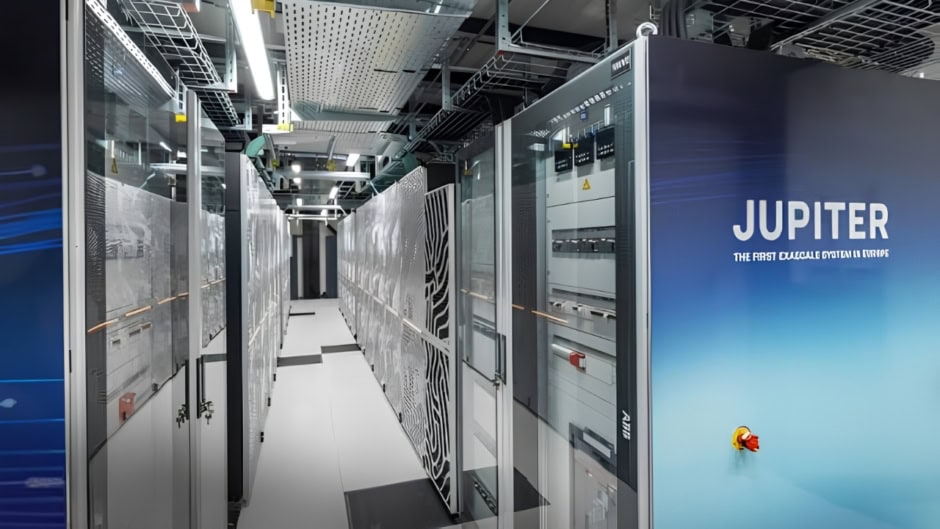
NVIDIA simulated a 104-qubit fault-tolerant quantum computer on JUPITER, Europe’s first exascale supercomputer. The simulation ran at Germany’s Jülich Supercomputing Centre and represents the largest comprehensive simulation of its kind to date. In fact, NVIDIA says the work helps test quantum computer designs before the hardware exists.
The company announced the milestone on October 21, ahead of GTC Berlin 2026. The simulation modeled magic state cultivation, a technique for producing special quantum states that fault-tolerant calculations need. Furthermore, NVIDIA says its method uses 90% fewer qubits than previous approaches to generate these states. The entire simulation ran on conventional hardware, not a quantum processor.
Magic states are specific qubit arrangements that fault-tolerant quantum computers consume during calculations. As a result, any improvement in producing them directly reduces the difficulty of building a practical quantum machine. The simulation also included realistic hardware noise, such as interference from control equipment, rather than ideal conditions. In addition, it tracked about 35.2 trillion complex amplitudes across its state vector.
The 104-qubit run used 8,192 NVIDIA GH200 Grace Hopper GPUs across JUPITER’s infrastructure. Before scaling to JUPITER, researchers first developed and tested the model on an NVIDIA GB200 NVL72 system at the NVIDIA Accelerated Quantum Research Center. They scaled tests from four GPUs to hundreds before moving to JUPITER’s full capacity. Consequently, that staging work reduced the simulation timeline from weeks to days.
In November 2025, Jülich ran a 50-qubit simulation on JUPITER under noise-free conditions. However, the new 104-qubit simulation more than doubled the qubit count and added realistic noise modeling. JUPITER itself opened in September 2025 as Europe’s first exascale system, capable of more than a billion billion calculations per second.
“Useful quantum computing will require fantastically complex, fault-tolerant systems,” NVIDIA CEO Jensen Huang said. Meanwhile, Jülich Supercomputing Centre director Kristel Michielsen said “Europe’s investment in JUPITER gives researchers the ability to investigate questions that were previously beyond reach.”
The announcement came days before Huang’s keynote at GTC Berlin. It also came shortly after Germany signed an AI partnership with NVIDIA at an investment summit in the city. NVIDIA says the simulation could accelerate progress in drug discovery, financial modeling, and materials science.