Pakistan’s first-ever State of Freedom Report, published by Mishal Pakistan in 2026, documents the country’s digital landscape through a dual lens: remarkable infrastructure growth alongside persistent constraints on how freely citizens can access, share, and express information online.
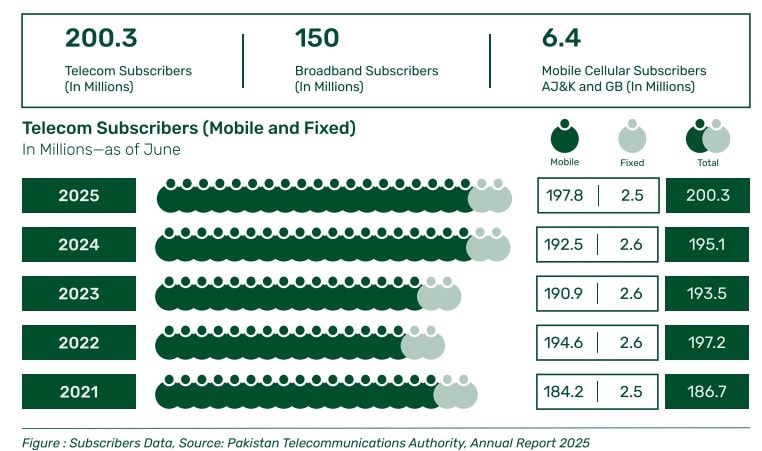
On the infrastructure side, the numbers are significant. Pakistan now has over 150 million broadband users, supported by a national fiber-optic backbone exceeding 230,000 kilometers, more than 58,423 cellular towers, and international submarine cable capacity that has crossed 17.21 Tbps, with 27,727 petabytes of total data usage. Mobile subscriptions exceed 190 million, internet penetration has crossed 60%, and nearly 70 million Pakistanis are active social media users. The Connect Pakistan 2030 strategy sets forward-looking targets including 100 Mbps baseline speeds, 10 million fiber-connected households, and regional AI and cloud hub status.
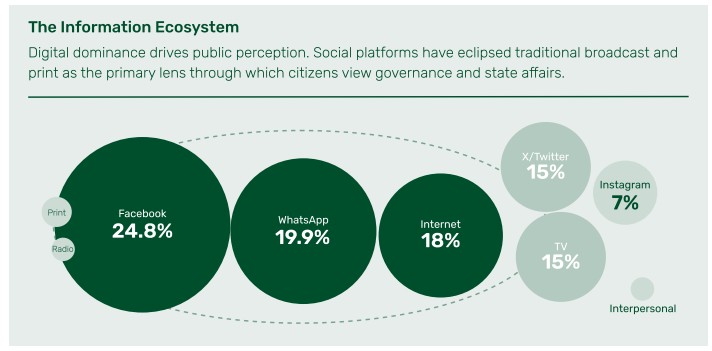
Public information consumption has shifted heavily toward digital platforms. The report’s National Trust Survey of over 2,000 respondents found that 24.8% of Pakistanis identify Facebook as their primary information source, followed by WhatsApp at 19.9%, websites and online platforms at 18%, and X at 15%. Traditional television now trails these platforms as a primary news source. However, approximately 55% of respondents expressed reservations about access to unbiased information, reflecting widespread concern about misinformation and algorithm-driven polarization.
The report also documents the scale of Pakistan’s regulatory engagement with global platforms. Between May 2025 and May 2026, the government filed 15,391 content-related requests across seven major platforms. Meta’s Facebook received 6,401 reports and actioned 3,600 at a 56.3% compliance rate. X received 4,260 reports but actioned only 668, a compliance rate of 15.32%. TikTok received 2,986 reports and actioned 1,639 at 54.89%. YouTube received 106 reports and actioned 16 at 15.09%. Instagram’s compliance rate was the highest at 66.94%, while WhatsApp and Telegram both exceeded 71%. Total platform reach affected across all reported accounts stood at 301.9 million.
The report frames Pakistan’s digital environment as operating across four pillars: access and inclusion, freedom of expression and information, privacy and data protection, and digital safety. On data protection, it identifies a critical gap: Pakistan still has no fully enacted standalone data protection law.
A draft Personal Data Protection Bill remains under consideration for several years, leaving protections fragmented and unevenly enforced. On internet disruptions, the report acknowledges that temporary shutdowns and service throttling during politically sensitive periods continue to affect economic activity and access to emergency information. The report stops short of calling these measures unjustified but notes the absence of consistent transparency mechanisms makes proportionality difficult to assess.
You can read the report here.