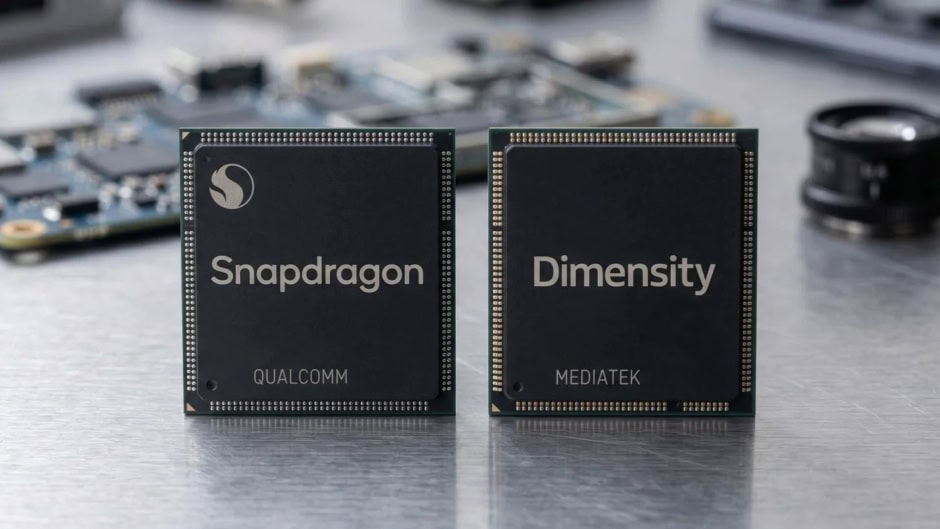
Qualcomm and MediaTek are preparing their next flagship smartphone chipsets with major upgrades in performance and efficiency. New leaks now offer an early look at what both companies may have planned.
According to the source, Qualcomm’s Snapdragon 8 Elite Gen 6 Pro, also known as the SM8975, could use TSMC’s new N2P 2nm process. The chipset may also push smartphone CPU speeds beyond 5GHz. Its eight-core CPU is reportedly arranged with two Prime cores at 5.01GHz, three cores at 4.03GHz, and three cores at 3.74GHz.
For comparison, the Snapdragon 8 Elite Gen 5 features two cores at 4.61GHz. Its other six cores run at 3.63GHz.
MediaTek’s Dimensity 9600 Pro is also expected to use TSMC’s N2P process. However, it will reportedly rely on Arm-designed CPU cores instead of Qualcomm’s custom designs. The leaked configuration includes two Canyon cores at 4.55GHz, three Gelas-b cores at 4.35GHz, and three Gelas cores at 3.10GHz.
The names are not official, but they could point to Arm’s upcoming CPU designs. Canyon may refer to the C2-Ultra, while Gelas-b could be the C2-Premium. Gelas may refer to the older C1-Pro.
Qualcomm is also expected to bring a new Adreno 850 GPU to the Snapdragon 8 Elite Gen 6 Pro. The GPU could feature three slices and 18MB of graphics memory. The Pro model may also include 8MB of Last Level Cache, or LLC. Qualcomm is reportedly planning two Snapdragon 8 Elite Gen 6 variants.
The standard Snapdragon 8 Elite Gen 6, identified as SM8950, could use the same 2+3+3 CPU layout. Its clock speeds remain unclear, while graphics are expected to come from the Adreno 845. The standard model may use two GPU slices with 12MB of graphics memory. Its LLC could also be reduced to 6MB.
Meanwhile, the Dimensity 9600 Pro is expected to feature Arm’s G2-Ultra NX MC12 GPU. This is the same GPU reportedly used in Xiaomi’s Xring O3 chipset. The GPU is said to have 16 cores split into two clusters. Eight cores will handle traditional graphics, while eight will include NX tensor acceleration.
This design could support features such as image upscaling and frame generation in games. Still, Qualcomm and MediaTek have not officially confirmed these specifications.