The internet has become an unprecedented platform for free speech, allowing diverse opinions to flourish like never before. However, not everyone agrees with the views shared online, often leading to heated debates and strong disagreements.
In certain instances, governments find it necessary to intervene and request the removal of specific content from their jurisdictions. Over a five-year period, data reveals that governments are more inclined to demand the removal of controversial films from YouTube than from Google Search results.
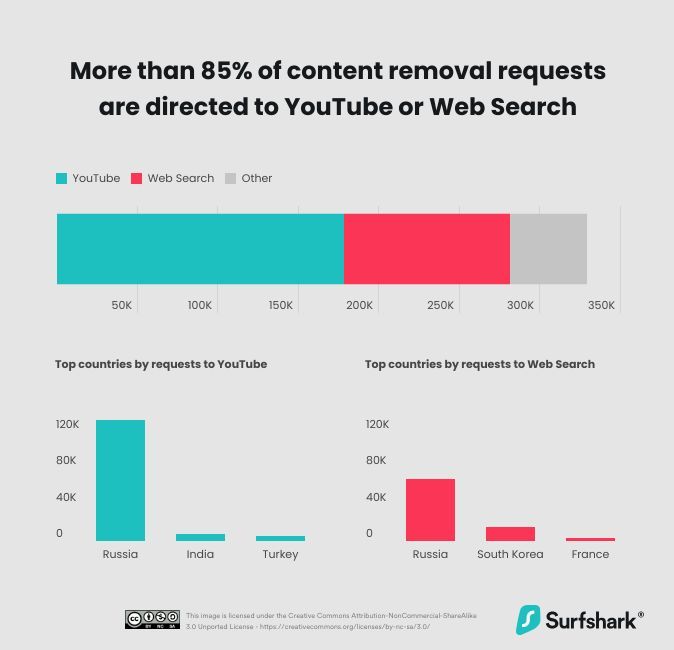
The study examined the content removal requests received by Google during a five-year period, beginning in 2020, and found that Internet shutdowns and material removal have grown frequent. Surfshark is a popular VPN service provider. A study of more than 300,000 takedown requests from courts and governments around the world found that 54% were about YouTube content, 31% were for Search, and the other 15% were for all other Google services combined.
According to the survey, Russia led in takedown submissions for YouTube and Google Search, followed by India with 8,000 requests for the video-sharing site and Turkey with 6,000 requests during the last five years. In a major assault on search results, South Korea ranked second, behind only Russia, with nearly 16,000 demands to remove information. Ignoring Russia’s enormous data manipulation doesn’t change the fact that 70% of Google’s contributions came from YouTube and Search queries combined.
Interesting Results: How Might the Decade Shape Up?
Although there is no universally accepted explanation for content removal, Surfshark’s research does classify them into a few categories. Defamation was the top cause in 2020 and fraud was one of the key ones in 2023, out of five years where data was collected; privacy and security were prominent reasons in four of those years. There were 96,000 submissions from countries citing national security as the cause for deletion.
Although there are valid reasons to request the removal of information, it should be noted that Surfshark’s study may not provide a comprehensive view. For example, only 150 countries’ data were reviewed, and entries for 2024 were tracked until June. Furthermore, the amount of requests rather than the quantity of products in each request is the primary emphasis of the study. Russia may have made one request for each piece of content, while the countries with fewer submissions may have actually requested more deletions.
Regardless, when looking at which countries restrict access to YouTube and Search, the US isn’t exactly a top contender. The full study summary is available on Surfshark’s website.