Pakistan has signed an initial agreement to acquire the Shenyang J-35 stealth fighter of China, marking the first confirmed move of the country toward fifth-generation air combat capability.
The Pakistan Air Force (PAF) made the announcement on Thursday at a press conference held in Islamabad, one year after its air clash with India in May last year.
PAF deputy chief of air staff Air Vice-Marshal Tariq Ghazi confirmed the deal but did not disclose the number of aircraft or financial terms involved in the agreement.
Islamabad had previously disclosed in June that Beijing offered forty J-35 warplanes alongside KJ-500 early-warning aircraft and HQ-19 surface-to-air missile defence systems.
Fleet expansion and upgrades announced
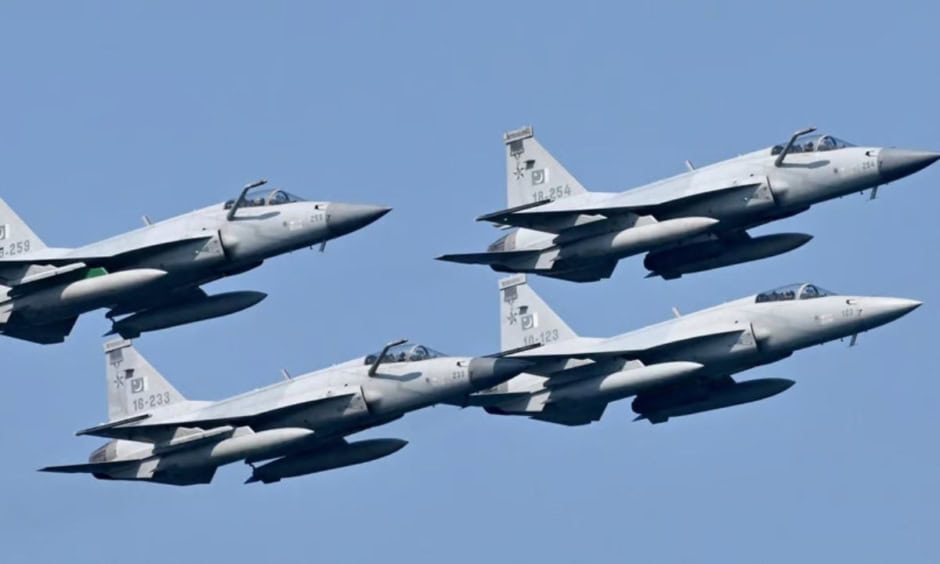
Ghazi told reporters that “foundations have been laid” for acquiring long-range precision weapons, next-generation platforms, additional J-10C aircraft, and significantly upgraded JF-17 fighters.
The PAF plans to procure further Chengdu J-10C fighters and carry out substantial upgrades to its existing fleet of JF-17 jets co-produced with China.
Pakistan joined the Kaan fifth-generation fighter project of Turkey shortly before its brief but significant aerial confrontation with India in May last year, officials confirmed.
The next-generation platforms referenced by Ghazi include emerging technologies such as hypersonic boost-glide vehicles, which represent a significant advance in offensive air capability.
Ghazi described the JF-17 upgrades as a stepping stone toward full fifth-generation fighter capabilities, which Pakistan intends to acquire progressively over coming years.
Shift in South Asian air power
Defence analysts say the induction of J-35 stealth jets would alter the air power balance between Pakistan and India, which operates a larger fleet of 4.5-generation fighters.
India currently fields advanced aircraft purchased from France and Russia but has not yet acquired any fifth-generation stealth fighters, leaving it behind Pakistan in that regard.
Amalendu Misra, professor of international politics at Lancaster University, said the technology transfer would “massively strengthen” the China-Pakistan all-weather strategic partnership significantly.
Retired Indian Air Force squadron leader Vijainder Thakur said the acquisition would “certainly make the PAF a more dangerous adversary” than it currently is for India.
Thakur added that even two to three J-35 squadrons could significantly reduce the numerical advantage of India by forcing its Su-30MKI fleet into continuous air defence roles.
India’s response and strategic concerns
New Delhi has chosen to focus entirely on its indigenous Advanced Medium Combat Aircraft programme rather than purchasing American F-35s or Russian Su-57 stealth fighters.
Misra said India had been rapidly expanding its Rafale fleet through large purchases from France, building a growing numerical edge over the PAF in 4.5-generation aircraft.
However, Pakistan acquisition of Chinese fifth-generation fighters may force India to reconsider and purchase a new squadron or two of Russian Su-57 stealth jets.
South Asia security researcher Muhammad Faisal at the University of Technology Sydney said Beijing’s decision to supply J-35s would have required approval from the highest levels.
Faisal noted China finalised its earlier deal to supply Pakistan with thirty-six J-10C jets only after India received its first Rafale deliveries from France in 2021.
Regional deployment and US relations
The J-35 acquisition would also expand the ability of Pakistan to project military air power beyond South Asia into the Persian Gulf and wider Middle Eastern region.
Pakistan deployed a fighter squadron, including JF-17s, to Saudi Arabia last month under a mutual defence pact both countries signed in September of last year.
Misra warned that Islamabad must proceed cautiously, as its improving ties with the United States are not guaranteed and may be strained by heavy Chinese arms purchases.
“By over-relying on Beijing to upgrade its arsenals, Islamabad risks gaining the wrath of Washington,” Misra said, highlighting the delicate diplomatic balance Pakistan must maintain.
The operational life of Pakistan’s ageing American-built F-16s, now 20 to 24 years old, is being extended to 2040 under an upgrade contract Washington approved on 1 May.
That US approval came on the same day China publicly rolled out the first fully operational export version of the J-35 warplane, in a striking coincidence of timing.
Speculation is growing that Pakistan could take delivery of an initial batch of J-35 stealth jets before the end of the current calendar year, analysts say.