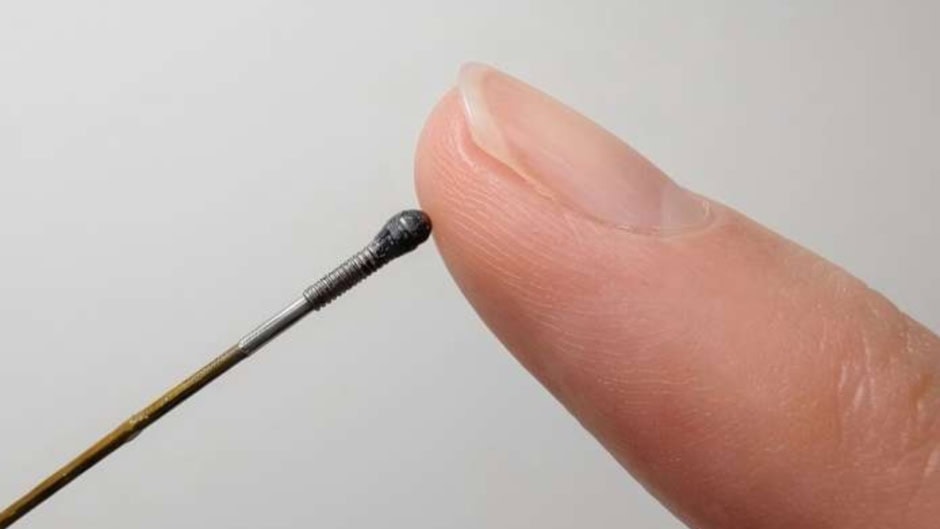
Researchers at Shanghai Jiao Tong University developed an optical force sensor measuring just 1.7 millimeters that enables robots to detect pressure.
The breakthrough invention also allows these robots nuanced sliding movements and twisting forces from all directions simultaneously. The grain-of-rice sized device uses light instead of traditional electronics to measure forces, making it small enough to integrate into minimally invasive surgical tools and robotic systems requiring extreme precision.
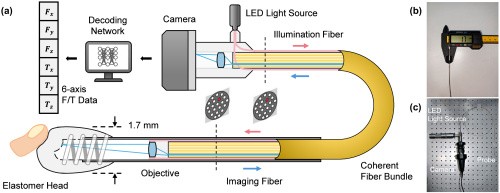
The sensor consists of an optical fiber with a soft elastomer tip that deforms slightly when it contacts an object. Even tiny deformations change how light distributes in the optical cavity inside the tip. These deformations form light patterns that travel through a coherent fiber bundle to a camera capturing the pattern as an image. The coherent fiber bundle preserves spatial information in transmitted light patterns. This allows all sensing to be performed through a single optical channel without complex wiring.
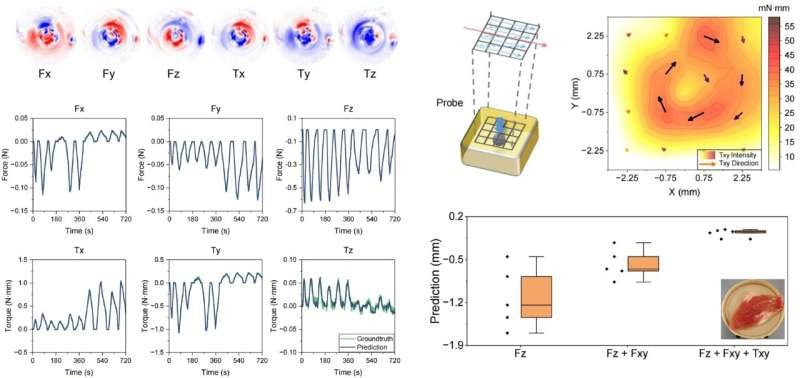
Lead researcher Weiyi Zhang published the findings in Optica journal under the title “Deformation-encoded light-field transduction enables 6-DoF optical force sensing in a 1.7 mm footprint.” The sensor provides six-degree-of-freedom force sensing, meaning it detects normal forces, shear forces, and torques along three perpendicular axes simultaneously. This comprehensive sensing capability previously required multiple sensors or complex structures that proved too large for microscale applications.
The technology addresses a critical limitation in robotic systems that can build cars with near-perfect accuracy but struggle with delicate tasks requiring gentle touch. Robots applying excessive pressure during eye surgery or working inside blood vessels risk causing damage. Human surgeons intuitively avoid these through tactile feedback. The optical sensor gives robots similar sensitivity while fitting inside instruments navigating spaces smaller than a fingernail.
Traditional force sensors rely on electrical components including strain gauges, capacitive elements, or piezoelectric materials that convert mechanical stress into electrical signals. These approaches require multiple sensing elements positioned at different locations to capture forces from all directions. The Shanghai Jiao Tong University team simplified this by developing a single optical signal measuring forces and torques simultaneously, reducing manufacturing costs and integration complexity.
The research team developed the sensor as part of broader efforts to create optical sensing technologies for minimally invasive surgery and robotic systems. The simple and inexpensive design contrasts with conventional solutions requiring multiple sensing elements or complex structures. However, researchers acknowledged additional development is needed before commercialization. This includes integration into relevant tools, testing under realistic long-term operating conditions, and packaging the system into compact user-friendly forms.
The advancement comes as surgical robotics markets expand globally with systems like da Vinci Surgical System performing millions of procedures annually. Current robotic surgical platforms rely on visual feedback and position sensors but lack comprehensive force feedback, limiting surgeons’ ability to feel tissue resistance during procedures. The grain-of-rice sensor could enable next-generation surgical robots with haptic feedback systems providing surgeons real-time force information through controller vibrations or resistance.
Industry observers noted the core technology feels genuinely promising despite requiring further refinement. The simpler design built around a single optical channel and camera often makes technologies easier to improve and scale over time once engineering matures.
The research team is currently working on fitting the sensor into actual robotic surgical tools and testing it in environments closer to real operating rooms. The goal is to replicate performance under sterile conditions and repeated use cycles becomes critical for operations.