Chinese researchers developed a lithium-sulfur battery design that could significantly extend drone flight times according to a study published in Nature. The research team led by Tsinghua Shenzhen International Graduate School created a molecular strategy improving reaction efficiency. However, the advance could push battery energy density far beyond current lithium-ion systems used in commercial drones.
Conventional lithium-ion batteries typically deliver less than 300 watt-hours per kilogram limiting flight duration and payload capacity. The new lithium-sulfur battery achieves 549 watt-hours per kilogram nearly doubling the energy density. Consequently, lithium-sulfur batteries are considered a promising alternative because sulfur is cheap, abundant, and capable of storing higher energy amounts.
One of the biggest challenges is the formation of soluble intermediate compounds during operation that drift through batteries. The researchers introduced what they called a premediator for sulfur electrochemistry to address this issue. Furthermore, the additive remains inactive until the sulfur reaction begins according to researcher Zhou Guangmin.
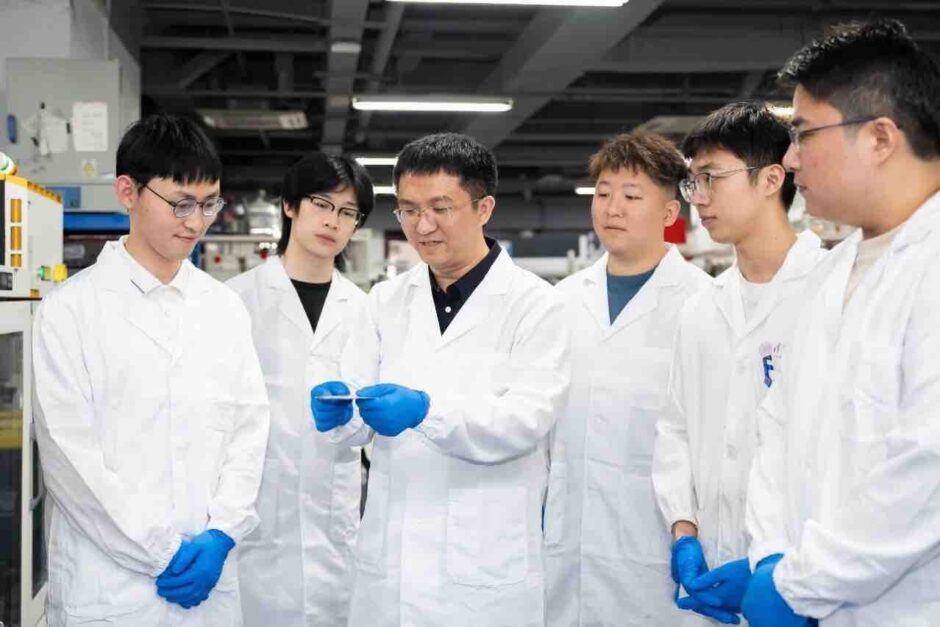
“Think of it as a special additive that sleeps inside the battery until it is needed. When the sulfur reaction starts, the additive wakes up right where the action is and begins to work,” explained Zhou Guangmin, a researcher at Tsinghua SIGS.
The team took a fresh approach by redesigning the reaction network at the molecular level. The new molecule they developed cuts the battery’s internal resistance by an impressive 75 percent compared to traditional designs. In testing, this innovative battery performed reliably over 800 charge-discharge cycles, maintaining almost 82 percent of its capacity. Even more exciting, the team created a practical prototype pouch cell boasting an energy density of 549 watt-hours per kilogram, which is nearly double that of many standard drone batteries on the market today.
“For drones, this matters a lot. Higher energy density means longer flight times, bigger payloads, and more working range. A delivery drone could fly farther to drop off packages. A power line inspection drone could cover more towers in one go. A search-and-rescue drone could stay in the air longer when every minute counts,” Zhou said.
The design creates faster reaction pathways and stabilizes the overall electrochemical process according to researchers. The breakthrough could enable drones to fly much farther on a single charge opening new paths for low-altitude aviation.