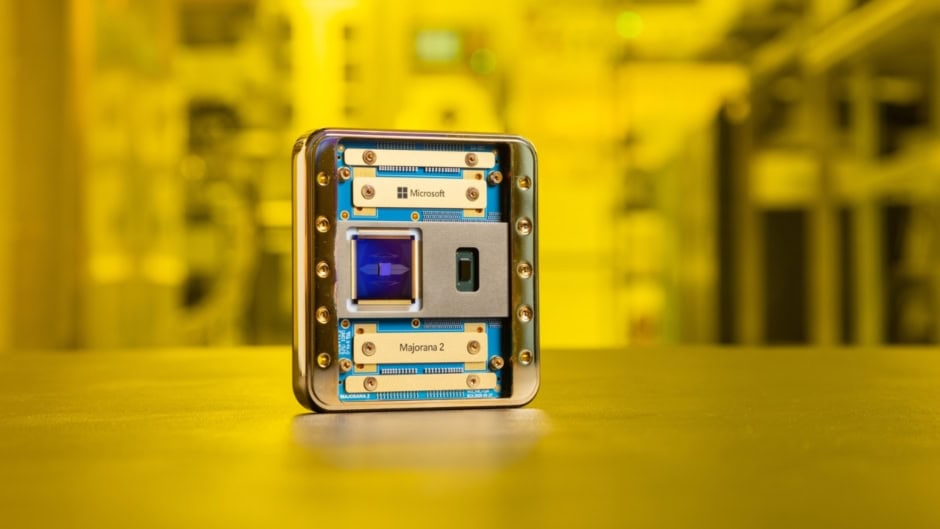
Microsoft has unveiled Majorana 2, a brand new quantum chip that the company says is 1,000 times more reliable than its previous version. Even better, it brings a working quantum computer much closer than anyone expected.
Here is why that matters. Quantum computers are insanely powerful, but they have always had one big weakness. Their basic building blocks, called qubits, fall apart in a fraction of a second. That makes real calculations almost impossible. Majorana 2 changes the game.
According to Microsoft, the average qubit lifetime in Majorana 2 has now reached 20 seconds, with some qubits even lasting up to a minute. This is a significant leap forward compared to the previous generation and could play a crucial role in tackling one of the biggest hurdles in quantum computing: keeping those delicate quantum states stable long enough to carry out meaningful calculations.
So how did Microsoft pull it off? It swapped materials. The old chip used aluminum. The new one uses lead, which shields the fragile qubits from outside interference much better. That one change made a massive difference.
“We’re 1,000 times better” than last year, said Microsoft technical fellow Chetan Nayak. He added that the team must keep improving every year to build something with real commercial value.
Here is the wild part. Microsoft used AI agents to help create the chip. Its Microsoft Discovery platform automated complex measurements, optimized manufacturing, and even dug through decades of research data to find hidden problems.
“Agentic AI has permeated almost everything we do,” Nayak said. The AI now feels like a natural part of the team, helping researchers spot patterns humans would easily miss.
Thanks to that boost and possible future Majorana iterations, Microsoft now expects a fully scalable quantum computer by 2029. That is half the time it predicted before.
Quantum computing could transform drug discovery, materials science, energy, and more. Microsoft also made its Discovery AI platform available to everyone, so other organizations can now use the same tools. However, Microsoft’s emphasis on topological qubits has stirred up some debate over the years.
Back in 2018, the company had to pull back a paper it published in Nature, where it claimed to have found evidence of the elusive Majorana particle. Despite this setback, they kept pushing forward, and by 2025, they unveiled their first Majorana chip. Still, Microsoft encountered a fair amount of skepticism, especially regarding their assertions about Majorana, from experts who remained unconvinced.