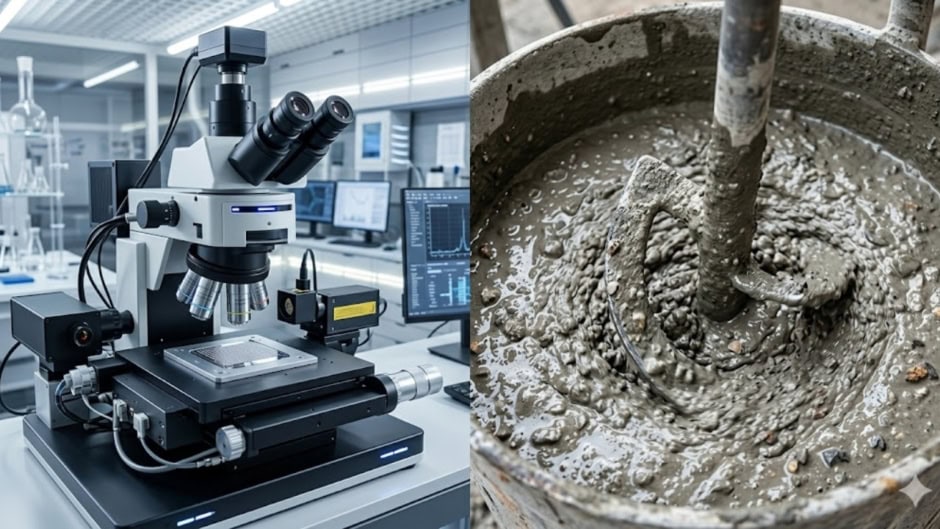
MIT researchers have finally observed the hidden chemistry that allows carbon dioxide to strengthen cement, solving a mystery that has puzzled engineers for years. The team used Raman confocal microscopy to track chemical reactions in real-time as CO2-injected cement hardened over the first 24 hours.
The discovery reveals a temporary chemical pathway that fundamentally changes how cement binds. When carbon dioxide enters fresh cement paste, it captures calcium released during cement dissolution. This initial reaction slows the normal hydration process and shifts the chemical environment throughout the material. Dissolved silicates then spread through the paste and form a silica gel network that exists only briefly.
Once the injected carbon dioxide fully mineralizes after several hours, standard hydration resumes. The calcium hydroxide that forms reacts immediately with the temporary silica network, producing calcium silicate hydrate, or C-S-H, the compound responsible for cement’s binding strength. Unlike conventional cement, this C-S-H develops uniformly throughout the entire material rather than clustering around individual cement particles.
The laser-based imaging technique allowed researchers to detect chemical bonds invisible to conventional tools. Graduate student Marcin Hajduczek noted that the silica gel’s sudden disappearance initially seemed like an error in the data before the team recognized it as a consistent and repeatable feature. The more uniform internal structure created by this process delivers measurable performance gains.
In tests, cement paste containing CO2 equal to one percent of cement weight achieved an average of 13 percent higher compressive strength after 24 hours compared to reference samples without CO2 injection. The findings also challenged assumptions that calcium carbonate particles drove strength development. The research reveals they function more as spectators than drivers.
Scientists caution that carbon dioxide dosage remains critical. Excessive CO2 can lock away too much calcium and disrupt beneficial reactions. With this new understanding of the mechanism, engineers can now optimize CO2 dosing and design stronger, lower-carbon cement products for infrastructure projects.
You can read the research paper here.