Researchers at the University of Minnesota have built a remarkable synthetic cell. They describe it as the first capable of completing a full life cycle. It marks a milestone in building living systems from non-living parts.
Called SpudCell, the artificial cell mimics core behaviors of life. It can grow, feed, replicate its DNA, divide, and pass genes onward. Earlier synthetic cell projects recreated only individual functions. SpudCell combines many life-like behaviors into a single engineered system.
The name carries a playful backstory. Lead researcher Kate Adamala named it partly as a joke, avoiding naming it after herself. It also nods to Sputnik, the satellite that launched the space age. She has called it an incredibly wimpy organism that mostly just eats and occasionally makes a daughter cell.
Associate Professors Kate Adamala and Aaron Engelhart led the work. They intend it as a proof of principle for the field. The idea is that core life behaviors can be recreated using chemistry. That means chemistry rather than modifying natural organisms.
“This is likely the most exciting project I’ve ever worked on,” said Kate Adamala. “We’ve replicated in chemistry what only used to be possible in biology: the complete set of behaviors of a cell. It proves that the most fundamental functions of life, like growth and replication, do not need a mysterious magical spark.”
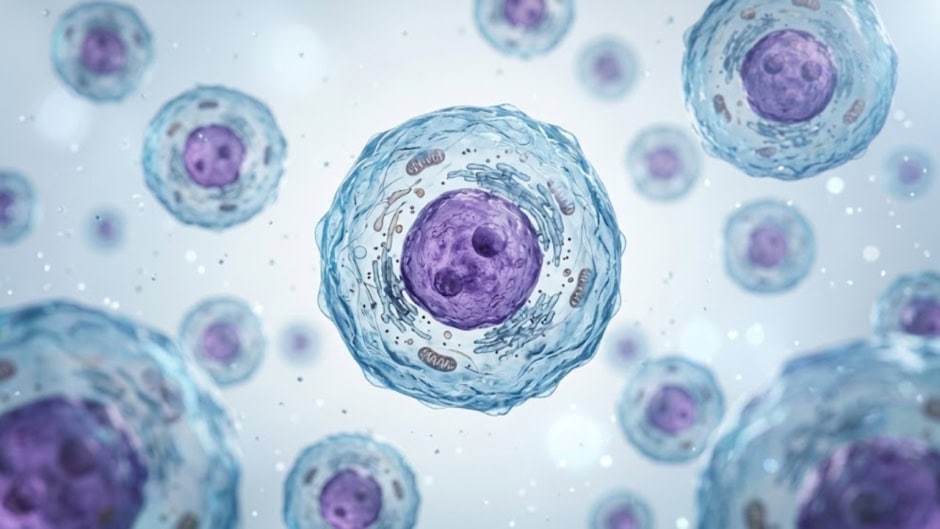
The cell is built from simple chemical building blocks. It uses liposomes, tiny water-filled spheres wrapped in fatty membranes. Synthetic DNA provides the instructions for basic cellular functions. The cells feed by fusing with tiny liposomes carrying enzymes and ribosomes.
SpudCell stays strikingly simple by design. It contains only 150 to 200 molecules in total. A natural cell holds millions or even billions of molecules. Its genome runs just 90 kilobase pairs across seven separate DNA plasmids. Biologists had once speculated a living cell needed at least 113 kilobase pairs.
That modular, plasmid-based design is a key advantage. It lets the team program different cell functions independently. Adamala says she knows the full ingredient list of the cell. That complete definition, she argues, is what makes it engineerable.
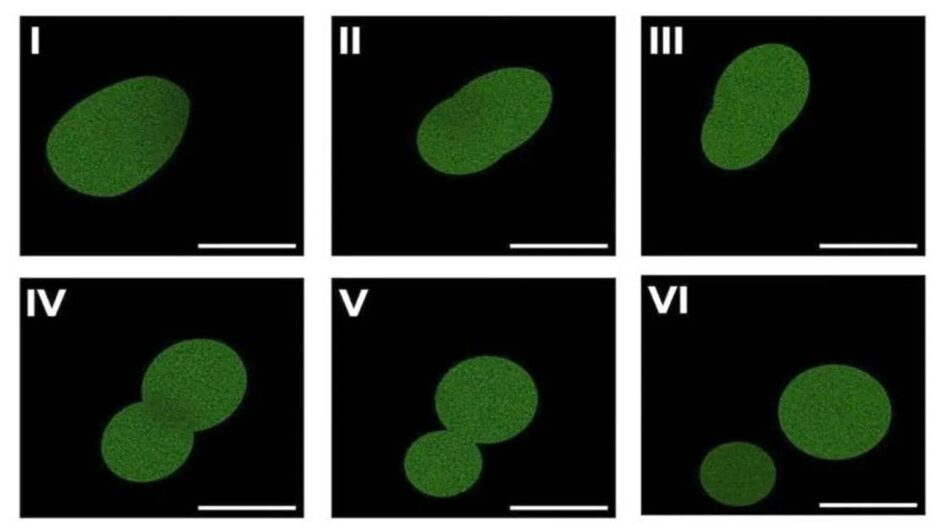
SpudCell also divides in an unusual way. Natural cells rely on an internal scaffold called a cytoskeleton to split. SpudCell instead uses proteins that build up on the membrane. Mechanical stress then causes the membrane to separate.
The pace remains slow and dependent, however. The cell takes about 12 hours to divide at 30 degrees Celsius. That is far slower than bacteria like E. coli. It also cannot make its own ribosomes and must be fed them.
The team even demonstrated natural selection in the system. A genetic tweak boosted production of a key protein. Those modified cells grew faster and produced more offspring. After five generations, they outcompeted the original population. Roughly 30% of cells still carried the same DNA after five generations.
The researchers say the platform could become a programmable tool. Scientists could design synthetic cells from scratch for specific tasks. Potential uses span medicines, materials, fuels, and even carbon capture. The team has launched Biotic, a public-benefit research organization, alongside Stanford’s Drew Endy.
Independent experts called the result striking but early. One computational cell biologist described it as a stunning scientific achievement. Others stressed SpudCell is not yet truly alive, since it cannot sustain division indefinitely or evolve on its own.
The work also comes with a notable caveat. The paper is a preprint that has not undergone peer review. It was reportedly rejected by the journal Cell, and Adamala shared it with journalists before wider scientific assessment. She says her team will submit it to another journal soon.
However, significant challenges remain before practical use. Future versions need a more stable genome and added molecular machinery. Adamala said the work is just the beginning. She called for a combined international effort.