Google overhauled how it ranks AI models for Android coding, and the update reshuffled the leaderboard developers rely on to pick their tools. The company’s Android Bench, launched in March, now runs on a new testing system called Harbor. The change reshaped the standings, with Claude Fable 5 taking the top spot.
Android Bench measures how well AI models handle real Android development tasks. These include updating old code to Jetpack Compose, handling wearable device networking, and fixing project-specific bugs. Unlike general coding benchmarks, it focuses only on Android software engineering using real-world scenarios.
The core change is the switch to the Harbor framework. The benchmark previously used mini-swe-agent, a general-purpose tool adapted for Android. Harbor runs tests inside secure sandbox environments, making it easier for developers to run independent evaluations and share clear data. Because the testing method changed, Google re-ran and rescored every model to set a fresh baseline.
Google also added eight new models to the leaderboard. These include Claude Fable 5, Claude Sonnet 5, Claude Opus 4.8, GLM 5.2, Kimi K2.7 Code, MiniMax M3, Qwen 3.7 Plus, and Qwen 3.7 Max. Claude Fable 5 now leads with a score of 84.5%, followed by GPT-5.5 at 80.2% and Claude Sonnet 5 at 76.2%. Among open-weight models, GLM 5.2 leads at 72.2%, followed by Kimi K2.7 Code at 70.4%.
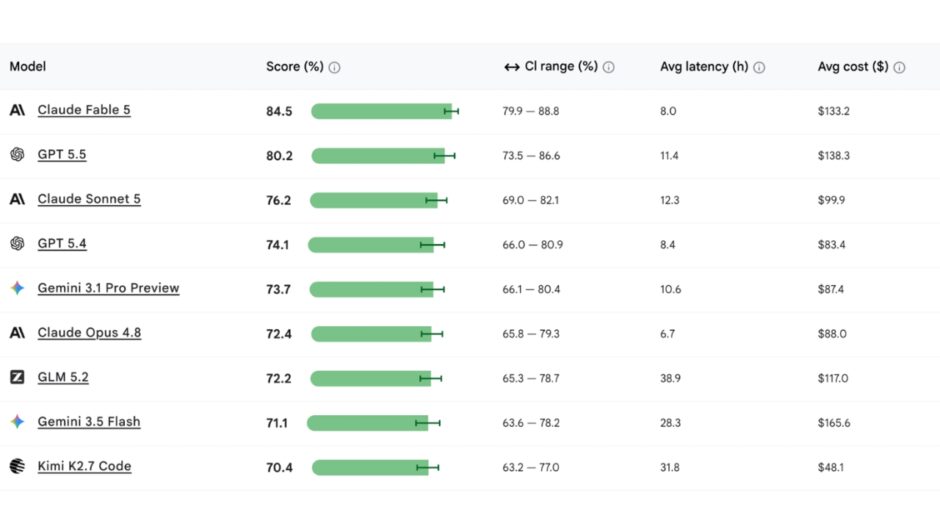
The results proved awkward for Google as its own Gemini models continued to lag on their home turf, trailing rivals in accuracy. Top performance also carries a cost. Running the benchmark on Fable 5 or GPT-5.5 costs more than $130 in tokens, while Gemini 3.1 Pro cost $87 for the same work. Google also opened the benchmark on GitHub, letting developers submit their own tasks and evaluations.