
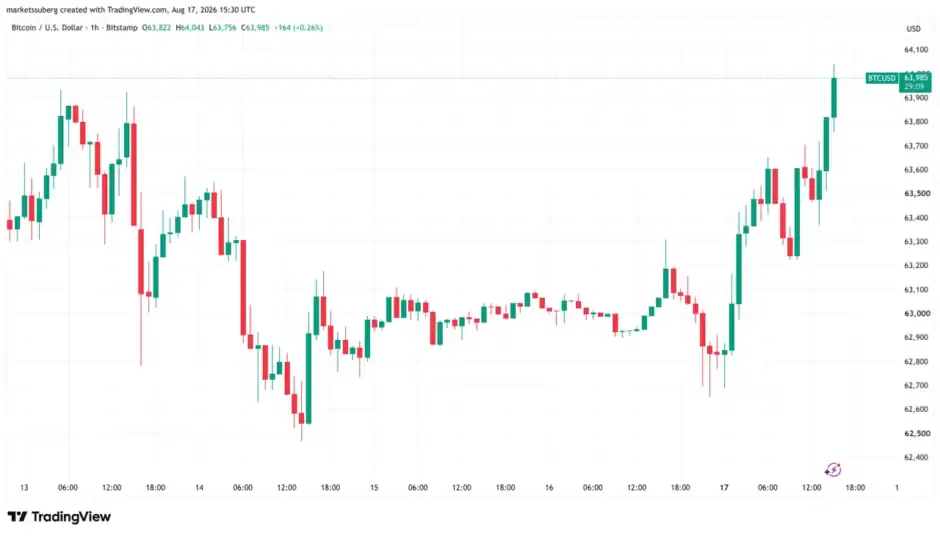
Bitcoin recovered above $64,000 on Monday as investors monitored rising geopolitical tensions between the United States and Iran, while gold prices climbed and US stocks weakened.
Bitcoin (BTC) gained more than 2% during Monday’s trading session, rebounding from Sunday’s weekly close and moving back above the $64,000 level, according to TradingView data.
The recovery came as US equities turned lower. The S&P 500 fell around 0.5% from Thursday’s record high as markets reacted to renewed uncertainty surrounding the expiration of a 60-day US-Iran ceasefire.
Gold also moved higher amid the geopolitical uncertainty. The precious metal gained more than 1% at the start of the week, reaching around $4,427 per ounce.
Gold-backed exchange-traded funds have also attracted significant investment. Data cited in the report showed that the 30-day change in inflows into gold ETFs approached $12 billion through August 13.
Meanwhile, oil prices remained relatively stable despite renewed tensions surrounding the Strait of Hormuz. West Texas Intermediate (WTI) crude was trading around $82.35 per barrel.
Despite Bitcoin’s rebound, derivatives market data points to increasing bullish positioning among traders.
Bitcoin funding rates reached 0.022 on August 14, their highest level in around 20 months, according to CryptoQuant data. The elevated funding rates indicate that long positions have become increasingly dominant.
CryptoQuant noted that derivatives-market sentiment remains positive within Bitcoin’s current trading range, with many traders positioned for further gains.
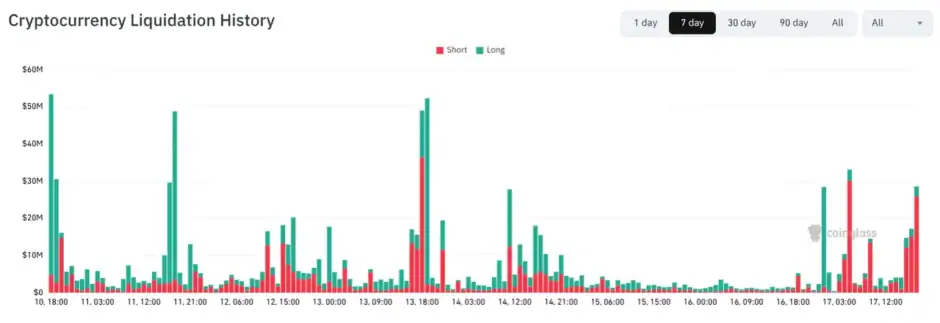
At the same time, liquidation activity remained relatively limited. Data from CoinGlass showed approximately $180 million in 24-hour crypto liquidations as Bitcoin moved back toward $64,000.
Analysts continue to watch the $61,000 level, where a decline could potentially trigger further unwinding of leveraged long positions.
For now, Bitcoin’s move above $64,000 marks a recovery from last week’s weakness, but elevated funding rates and heavy futures positioning could increase market volatility if the rebound loses momentum.