Pakistan’s decision to impose additional customs duties of up to 31% on imported motorcycle parts and vehicle tyres has sparked concerns over the country’s tariff policy and industrial competitiveness. A member of the National Tariff Policy Board has questioned the move, arguing that higher import duties conflict with the government’s efforts to reduce trade barriers and improve industrial efficiency.
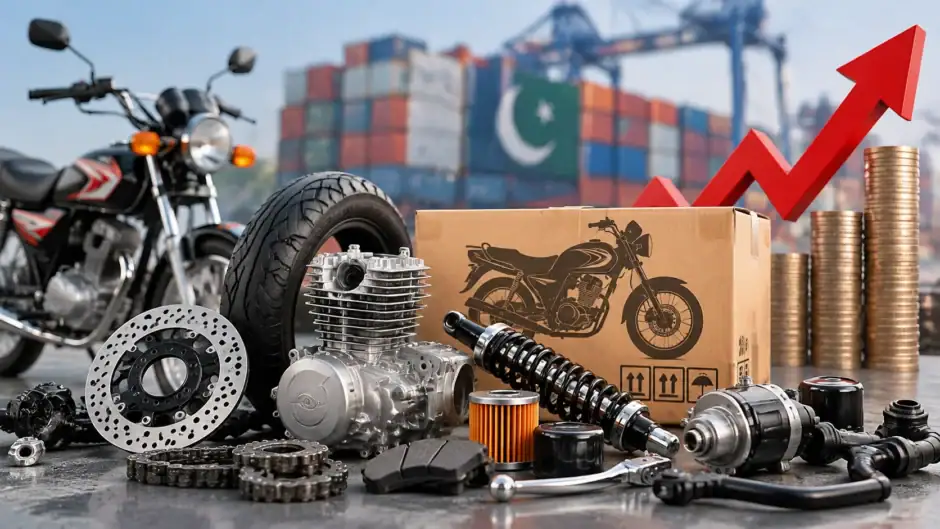
According to Dr Rubina Athar, who helped formulate the National Tariff Policy, criticised the decision to send the proposed duties to the Economic Coordination Committee (ECC) without first presenting them to the board. The Finance Ministry confirmed that the ECC had approved an additional customs duty of 11% on imported vehicle tyres and motorcycle parts, with the rate reaching 31% for certain components imported by manufacturers instead of being produced locally.
The affected components include licence plates, brackets, side reflectors, decorative parts, foot plates, wheel assemblies, windshields, seats, toolboxes and centre covers. However, imports of these parts from China remain exempt from the additional duties under the Pakistan-China Free Trade Agreement.
The Federal Board of Revenue (FBR) said the proposal originated from the Engineering Development Board under the Ministry of Industries and Production. The Ministry of Commerce stated that the ECC had approved amendments to SRO 693(1)/2006, which covers additional customs duties on certain locally manufactured parts imported by original equipment manufacturers in kit form.
Athar argued that import substitution policies have contributed to industrial inefficiencies without delivering meaningful benefits to consumers. Senior economist Vaqar Ahmed also warned that preferential tariff measures for selected sectors could undermine the objectives of the national tariff policy. Meanwhile, Nimir Chemicals CEO Zafar Mehmood said reducing customs duties alone would not necessarily lower business costs because companies also face other taxes and charges.
FBR Member Customs Shakil Shah called for removing withholding taxes collected at the import stage, arguing that they tie up business funds and can be difficult to recover when payments exceed actual tax liabilities. Rubatech CEO Zain ul Abideen also warned that the national tariff policy, combined with the new energy vehicle policy, could put pressure on Pakistan’s conventional automotive industry.
Athar maintained that competitive pressure was necessary to address industrial inefficiencies, while steel industry representative Wajid Bukhari said lower interest rates and energy costs had helped support the sector. The debate highlights concerns over balancing protection for local manufacturers with affordable prices, competition and long-term industrial growth.