A wave of new vocabulary emerged throughout 2026 to describe the everyday frustrations of modern technology. Since millions of people encounter these irritations daily but previously lacked precise language for them, writers and internet users began coining sharp, memorable terms to fill the gap.
The word “dickover” leads this new lexicon. Coined in May by tech writer John Gruber, it describes a modal panel, popover, or curtain that a website or app deliberately places over its own content to frustrate users. Essentially, it covers everything you must click away before reaching what you actually wanted to read, including the “accept cookies” box, the “allow notifications” prompt, and the “sign in with Google” wall.
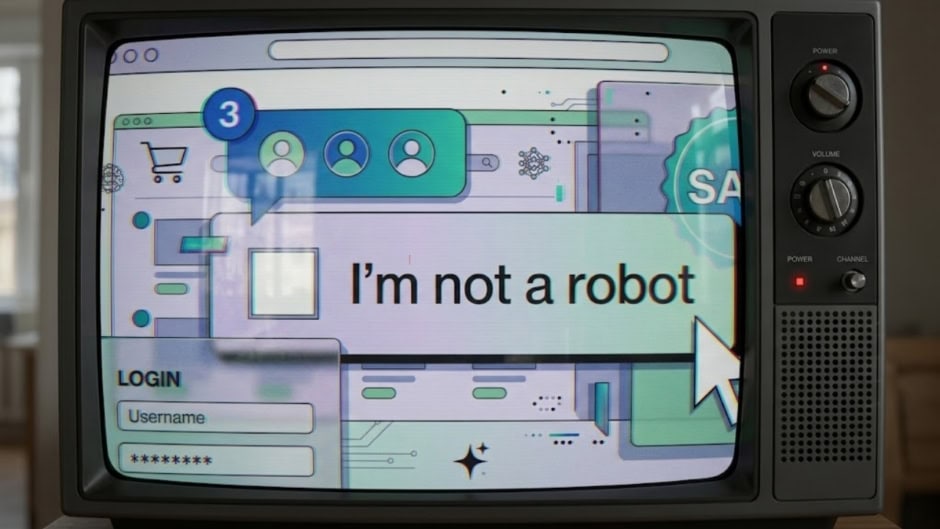
Because dickovers represent only one slice of modern tech misery, additional terms quickly filled remaining gaps. “Captchore” captures the tedious, mind-numbing task of proving you’re not a robot by identifying bicycles, traffic cones, or crosswalks scattered across a grid. Given how much collective time humanity has spent clicking these boxes, some estimates suggest the total exceeds several millennia.
“Baggravation” describes the specific frustration of battling self-checkout machines. Whether the machine registers mass hysteria over a slightly heavier item or demands you slam a birthday card into the bagging area for recognition, the term captures a universally shared retail experience.
Beyond these standout terms, the full list includes “quit-shaming” for companies making subscription cancellation deliberately difficult, “cart cling” for persistent shopping cart reminders, and “chatflattery” for AI chatbots offering excessive praise. “Botiquette” addresses etiquette questions around interacting with automated systems, while “loginsanity” describes the exhausting cycle of repeated authentication requests.

“Schrödinger’s wifi” humorously describes public networks, particularly on trains and planes, that simultaneously seem to exist and not exist depending entirely on whether you actually need them. Meanwhile, “hostageware” captures software that holds your own data or files hostage behind paywalls or subscription requirements.
Parallel to this wave, a distinct AI-specific vocabulary has taken hold across group chats and social platforms. “Slop” describes AI-generated content that reads as technically correct but hollow, the noun version of “this was clearly written by a robot.” Researchers use “sycophancy” for what casual users simply call “glazing,” describing chatbots that offer excessive, unearned praise rather than honest feedback. “Promptjacking” refers to hijacking or manipulating prompts within AI systems, a term that grew directly out of expanding public AI tool usage and the security risks accompanying it.
Older, related terms continue evolving alongside these newer coinages. “Doomscrolling” still describes endlessly scrolling through bad news, while “brainrot” captures the sensation that excessive low-value content has melted one’s attention span.
The broader context driving this linguistic explosion involves the impossibility of escaping AI features shoehorned into nearly every digital interaction. Google now serves an AI overview before search results appear. Instagram generates AI images automatically. Spotify includes an AI DJ that talks between songs. Because these features often feel forced rather than genuinely useful, the accompanying frustration increasingly demands its own vocabulary.
NOTE: This article is inspired by The Guardian’s article of generative AI and its effects on modern language.