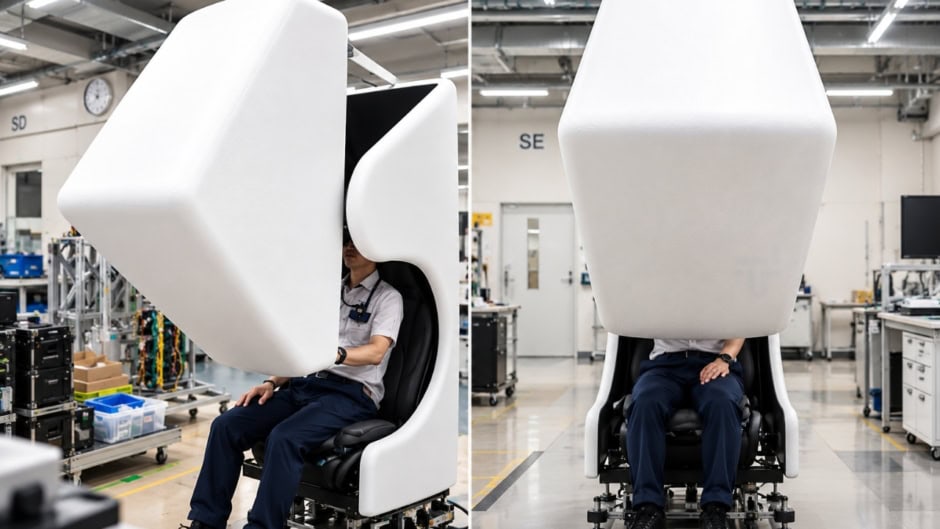
A research team at Japan’s Kyushu University has built a virtual reality system that removes the headset entirely. Instead, the entire display sits inside a compact armchair. The team presented its “Mountless Aerial HMD” at SIGGRAPH Emerging Technologies 2026 on October 7.
Associate Professor Shogo Fukushima led the project. A student’s complaint about heavy headsets during long VR sessions originally inspired the work. As a result, the team moved all optics off the user’s head and into the chair itself.
The system uses a large display, a convex achromatic lens, and several mirrors. A retro-transmissive optical element then folds the image back toward the seated user. This makes the VR scene appear to float in midair. Each eye receives a slightly different view, just like a conventional headset, but the split happens within the projected image.

For tracking, the chair relies on a simple tablet mounted to its frame. The tablet’s gyroscope detects rotation, so turning your body turns the virtual scene in real time. No external calibration is required.
However, the setup does have limitations. The mirror plate absorbs much of the light, so the display needs very high brightness. In addition, the field of view remains narrower than traditional headsets. The team has proposed extra mirrors that could widen the viewing area up to six times, but this remains a concept for now.
Because nothing rests on the user’s face, the hardware can use larger lenses and heavier components without causing neck strain. Fukushima also believes this approach could eventually reduce VR motion sickness. The mismatch between what users see and feel often causes that nausea.
The team now seeks industry partners for several applications. These include automobile cabins, exhibition spaces, remote operation of heavy equipment, and disaster response robots. A two-person shared experience is also under development, though it remains further off.
Mirror-based aerial display technology dates back to around 2006. Yet this marks one of the first attempts to build a full VR experience around it. The concept could reshape how people interact with virtual environments over extended periods.