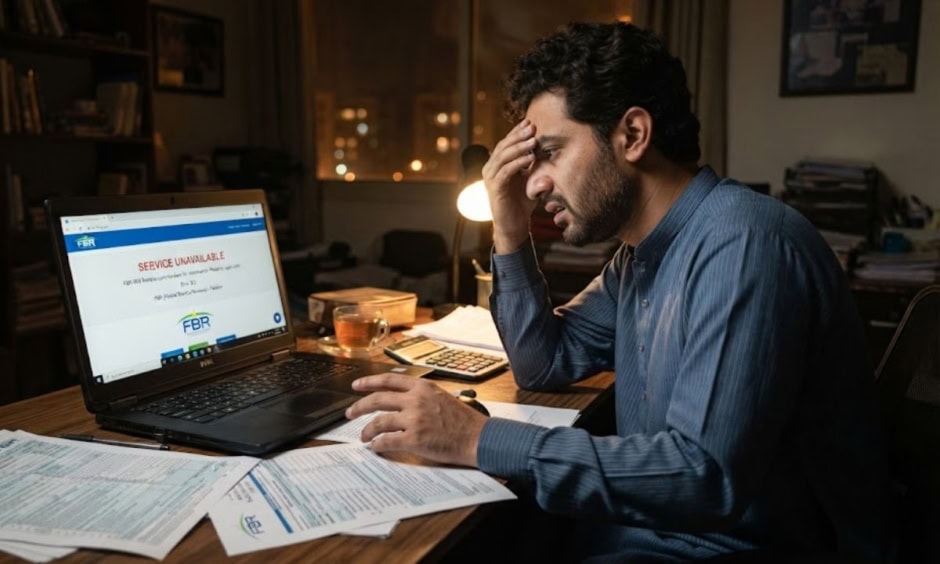
The Lahore High Court (LHC) has ruled that uploading an appellate order to the Federal Board of Revenue’s (FBR) Inland Revenue Information System (IRIS) does not amount to valid service under the Income Tax Ordinance, 2001.
A division bench comprising Justice Mirza Viqas Rauf and Justice Anwaar Hussain decided three connected reference applications filed by Tahir Mehmood. The applications challenged three orders of the Appellate Tribunal Inland Revenue, which had dismissed the taxpayers’ appeals as time-barred, holding that uploading the orders to IRIS constituted sufficient service.
In one case, the taxpayer argued that Covid-19 and quarantine after a foreign trip had prevented him from accessing the portal. In the other two, the taxpayers said they learned of the Commissioner (Appeals)’s orders only after receiving recovery notices in April 2026, months after the orders were passed.
Justice Hussain, who authored the judgement, held that Section 218(1)(d) of the ordinance recognises electronic service only when it is carried out in the prescribed manner. He noted that Rule 74 of the Income Tax Rules limits an electronic address to a fax number or an email address and requires confirmation of transmission.
The judge observed that IRIS is an internal, web-based workflow system for tax administration. Placing an order in a taxpayer’s account, he said, does not establish its transmission to an electronic address as the rule requires. He distinguished between accessibility and service, noting that an order may be accessible without having been served in accordance with the law.
The court held that the limitation period cannot begin from an event the law does not recognise as its starting point. It rejected the department’s argument that Rule 74 could not restrict the parent provision, stating that the requirement of service in the “prescribed manner” is part of the ordinance itself. The judge also dismissed the contention that taxpayers must routinely monitor IRIS.
On the pandemic-related explanation, the judge said the department could not dismiss it, as the correctness of the tribunal’s conclusion involved a question of law the high court was competent to examine.
The judge observed that technology is an instrument of statutory administration rather than an independent source of statutory authority, and that modernisation cannot dispense with legal safeguards.
The court referred to rulings of the Peshawar and Islamabad high courts and the Delhi High Court, as well as Articles 4 and 10A of the Constitution. The bench set aside the impugned orders and directed the tribunal to decide the appeals afresh on merit.