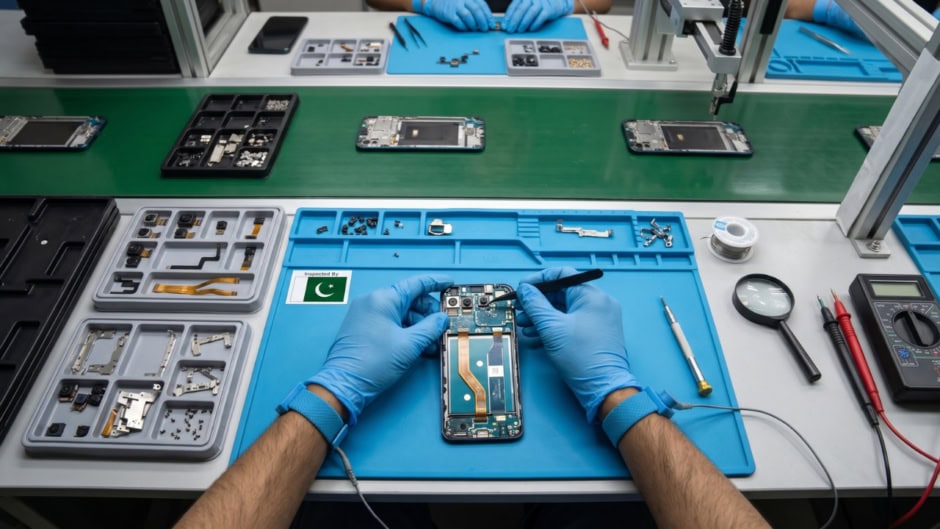
Pakistan is aggressively pushing to transform its local mobile phone manufacturing sector. The government is formulating a new Mobile Device Manufacturing Policy to shift the industry from import-dependent assembly toward robust local component manufacturing. Ultimately, the Ministry of Industries and Production aims to achieve up to 50% domestic value addition over time.
This upcoming policy builds upon the previous Mobile Device Manufacturing Policy 2020–2023. That initial framework successfully attracted domestic and foreign investments to establish assembly facilities across the country. Now, the government wants to move beyond basic assembly. Therefore, the new proposed policy focuses heavily on local component production, technology transfer, and the development of a supporting industrial ecosystem. Currently, domestic value addition in mobile device manufacturing hovers around just 10% to 20%.
Pakistan Local Mobile Manufacturing Dominates the Domestic Market
Meanwhile, local mobile phone plants are already meeting the bulk of domestic demand. Between January and September 2026, Pakistan produced an impressive 20.08 million handsets locally. In stark contrast, commercial imports stood at only 2.85 million units during the same period. The locally assembled devices included roughly eight million smartphones and 12 million 2G phones. Furthermore, data from the Pakistan Telecommunication Authority (PTA) reveals that smartphones now account for 71% of all active mobile devices on local networks.
Consequently, Pakistan’s reliance on imported finished handsets is decreasing rapidly. During the first quarter of fiscal year 2026-27, the mobile phone import bill fell significantly. In dollar terms, it declined by 16.6%, dropping to $417.24 million from approximately $500.01 million in the same period last year. Although imports saw a slight 7.1% month-on-month increase in September 2026 ($143.14 million compared to $133.66 million in August), they remained 28.2% lower year-on-year compared to September 2025.
A Shifting Competitive Landscape
Interestingly, the competitive landscape of local assemblers is shifting dramatically. During the first nine months of 2026, VGO TEL emerged as the absolute largest producer in Pakistan. It successfully overtook major international brands like Infinix and Itel. Previously, Infinix dominated the local assembly market in both 2024 (3.98 million units) and 2025 (3.65 million units). However, the latest production data shows output spreading across various manufacturers rather than concentrating in a single brand.
| Brand | Handsets Produced (Jan-Sept 2026) |
| VGO TEL | 2.50 million |
| Infinix | 1.96 million |
| Itel | 1.59 million |
| TECNO | 1.16 million |
| Samsung | 1.04 million |
| Vivo | 0.99 million |
| Nokia | 0.97 million |
| China Mobile | 0.72 million |
| X Mobile | 0.71 million |
| G’FIVE | 0.64 million |
Ultimately, the success and sustainability of Pakistan’s proposed manufacturing policy will depend on several crucial factors. The industry must develop a competitive local component supply chain. Furthermore, local assemblers must maintain competitive prices while navigating consumer demand, exchange-rate stability, and access to remaining imported components.