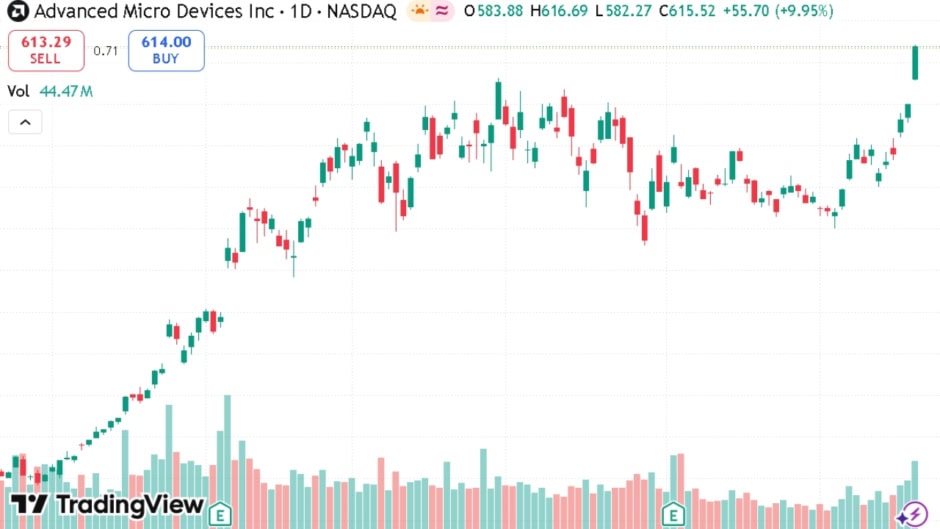
Advanced Micro Devices (more commonly known as AMD) briefly surpassed $1 trillion in market capitalization for the first time. Shares rose 9% to reach $610 per share, hitting an all-time high of $613.92 on Monday. This milestone makes AMD the fourth U.S. chipmaker to achieve a $1 trillion valuation, joining NVIDIA, Broadcom, and Micron in the exclusive club.
NVIDIA crossed the $1 trillion threshold in 2023 and now stands valued at more than $5 trillion as the world’s most valuable company. AMD remains regarded as NVIDIA’s closest competitor for graphics processing unit market share. However, AMD has accelerated its AI product launch pace significantly while expanding beyond selling individual chips to offering complete integrated systems combining processors, networking gear, and related hardware.
The company is capturing increased demand for central processing units deployed alongside graphics processors in servers handling AI inference workloads. This strategic positioning helps AMD gain market share directly from Intel, which has struggled with competitive AI offerings. Early last month, AMD forecast quarterly revenue exceeding Wall Street estimates but fell short of investor expectations, sending stock down more than 7% that day.
Since that earnings disappointment, AMD shares have climbed more than 26% as investors reassessed the company’s AI computing trajectory and competitive positioning. Wall Street appears convinced that AMD’s expanded system offerings and CPU momentum outweigh near-term guidance misses. The $1 trillion valuation reflects confidence that AMD will capture meaningful AI infrastructure spending as enterprises diversify suppliers beyond NVIDIA.
Industry observers note that AMD’s achievement signals sustained competition in AI computing infrastructure, a sector expected to accelerate through 2027. Complete system bundles from AMD appeal to customers seeking vendor diversity and integrated solutions. Reaching $1 trillion demonstrates investor conviction that AMD possesses the technology, production capacity, and strategic focus to maintain competitive relevance in the high-stakes AI acceleration race.