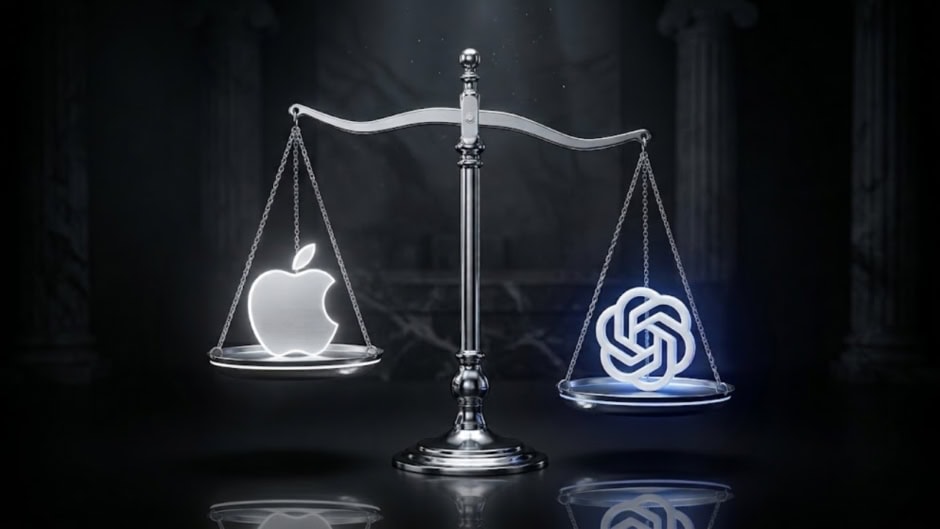
Two companies that once shook hands are now heading to court. Apple has sued OpenAI for trade secret theft, accusing the AI firm of a deliberate, coordinated campaign to steal its unreleased hardware secrets. The filing landed Friday in the Northern District of California, and its language is unusually blunt.
Apple has alleged that at every level, from technical staff to the chief hardware officer, OpenAI has been stealing Apple’s trade secrets and confidential information.
“This case is about Apple’s former employees stealing Apple’s trade secrets for the benefit of OpenAI. Apple brings this suit to put a stop to it,” the lawsuit says.
The complaint names two former Apple employees as defendants. Chang Liu, a former senior electrical engineer, allegedly kept a work laptop and exploited a bug to reach Apple’s cloud storage after leaving. According to the filing, he downloaded dozens of confidential hardware files, including specs for unreleased products. The suit also names Tang Tan, now OpenAI’s hardware chief, who once led iPhone, AirPods, and Apple Watch design.
The company frames this as theft designed to fast-track OpenAI’s own consumer devices. So the suit reads less like a dispute and more like an indictment. The lawsuit also details in on the allegations as:
When interviewing Apple employees for jobs at OpenAI, Mr. Tan uses Apple’s confidential information to gain access to even more insider knowledge. He has used an Apple internal project codename to ask, “What’s the plan[?]” for an unannounced Apple product.
He has directed job candidates still working for Apple to bring “Actual parts” from Apple to their interviews for “show and tell” sessions in which he and his team at OpenAI can elicit still more Apple confidential information. These directions to bring Apple’s parts to OpenAI job interviews surprised at least one of the candidates, who commented that he “didn’t even know we could take those from the office.”
OpenAI has been instructing Apple employees to bring “CAD/design artifacts” and “prototypes” to their interviews and to divulge details about their work such as “subsystem and component selection,” the “tools or methodologies you use for system integration, such as CAD software, simulation tools,” and “Vendor selection and communication/collaboration with vendors.”
In one instance, OpenAI reportedly had a partner reveal a metal-finishing technique under the false belief that Apple had approved it. Apple claims OpenAI coached departing staff on dodging security checks and hiding their next employer.
The two firms once partnered in 2024 to weave ChatGPT into the iPhone, yet more than 400 former Apple workers now sit at OpenAI. With OpenAI eyeing an IPO and readying its first hardware device, shaped partly by ex-Apple designer Jony Ive, the stakes are enormous.
OpenAI denies wrongdoing, saying it has no interest in others’ trade secrets. There are also reports of a counter legal action in development on OpenAI’s side.
You can read the full filing below and find the PDF linked here.