
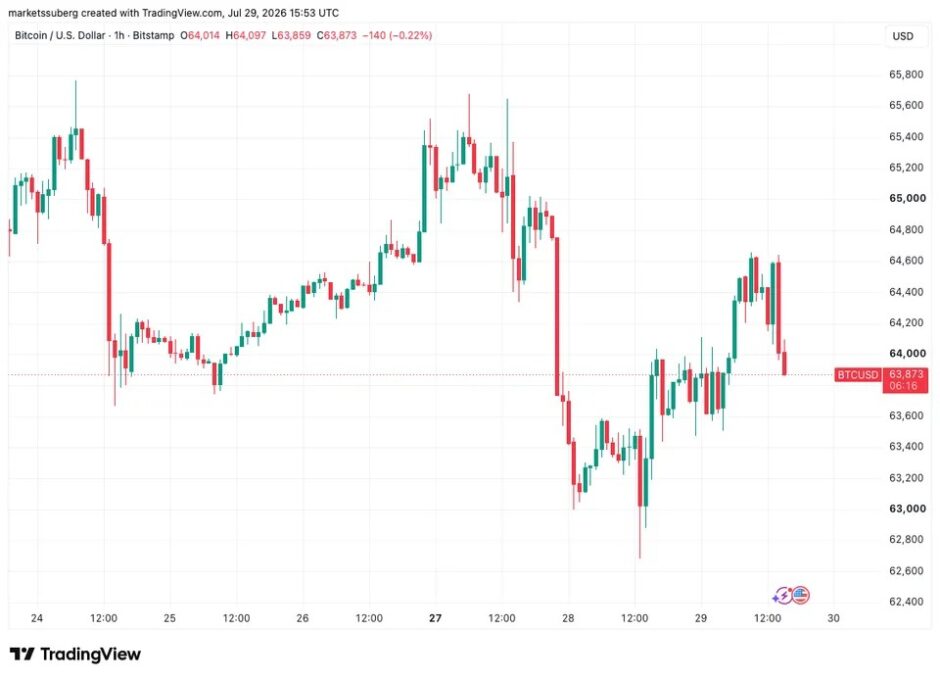
Bitcoin traded near $64,000 on Wednesday as investors navigated rising geopolitical tensions, a sharp increase in oil prices, and uncertainty ahead of the U.S. Federal Reserve’s latest interest rate decision.
The world’s largest cryptocurrency briefly fell to an 11-day low of $62,700 before recovering some losses during the U.S. trading session. Market volatility remained elevated as traders weighed multiple macroeconomic risks affecting global financial markets.
Investor sentiment was dampened by continued selling in Asian technology and semiconductor stocks, with concerns over debt levels and valuations among major AI and chip companies spilling over into U.S. markets.
Fresh geopolitical tensions in the Middle East further weighed on risk assets after renewed military exchanges involving the United States and Iran heightened concerns over global energy supplies.
The escalation pushed crude oil prices sharply higher, with West Texas Intermediate (WTI) crude rising 7.6% and Brent crude gaining 5.4%. Higher energy prices have raised concerns that inflation could remain elevated, potentially influencing the Federal Reserve’s monetary policy outlook.
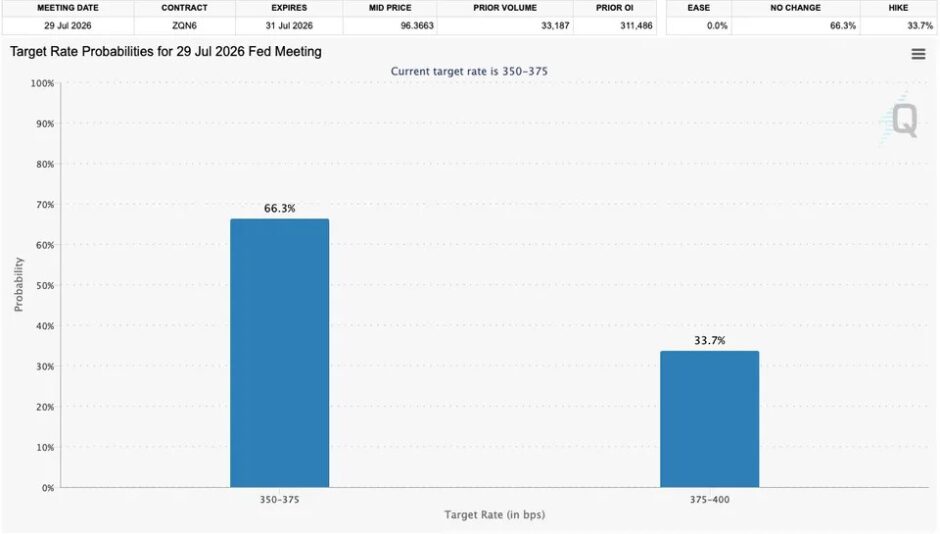
Investors are now awaiting the outcome of the Federal Open Market Committee (FOMC) meeting, where policymakers are expected to announce their latest interest rate decision.
According to the CME FedWatch Tool, market expectations remain divided, with 66.3% of traders anticipating the Federal Reserve will keep interest rates unchanged at 3.50%–3.75%, while 33.7% expect a 25-basis-point rate hike.
Bitcoin continued to trade within a narrow range between key technical support and resistance levels, with analysts noting growing liquidation clusters around $63,500 and $64,900.
Despite the recent price swings, overall trading activity remained subdued. Market data showed spot trading volumes near their lowest levels since July 2023, while futures open interest also stayed close to multi-year lows.
Analysts say investor interest has shifted toward artificial intelligence-related equities since the cryptocurrency market peaked in late 2025, contributing to lower trading volumes across digital assets.