The sodium-ion battery market is splitting into two distinct segments, and China’s two largest battery companies are leading the divide from opposite sides. CATL and Changan Automobile launched a mass-produced passenger vehicle featuring a 45 kWh sodium pack in June 2026, while BYD focuses its third-generation polyanion platform on stationary energy storage, targeting a manufacturing cost of $0.04 per watt-hour by 2027.
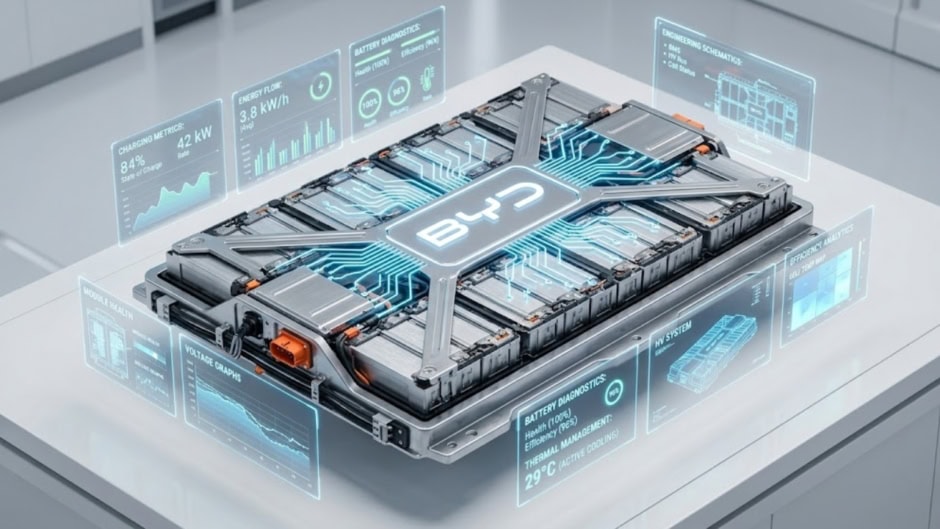
BYD’s grid strategy centers on its MC Cube-SIB ESS container, described as the world’s first high-performance sodium-ion battery for grid energy storage, built using the company’s Blade packing architecture.
The R&D cells achieved 200Ah capacity and over 10,000 cycles, with megawatt-hour-scale systems already deployed in pilot phases. That 10,000-cycle threshold translates to a 33-year operational lifespan under standard grid cycling conditions.
Laboratory data compiled in a June 8 industry depth report by Minmetals Securities outlines the distinct performance parameters of competing sodium-ion pathways.
| Performance & Abuse Metric | Polyanion (NFPP) Cell Baseline | Layered Oxide Alternative | Grid/Industrial Significance |
| Max. Thermal Runaway Temp. | 273.32°C | 484.51°C | Crucial for dense, indoor commercial energy storage installations. |
| Total Volumetric Gas Evolution | 93.1 L | 123.25 L | Optimises utility-scale grid power over weight-critical passenger cars. |
| Target Field Deployment | 200Ah long-form cell | Lower-capacity, high Wh/kg cell | Optimizes utility-scale grid power over weight-critical passenger cars. |
The chemistry behind BYD’s approach matters. BYD’s third-generation sodium-ion platform uses polyanion materials to solve sodium precipitation and heat issues, hitting 10,000 cycles, double the 2,000 to 3,000 typical of lithium iron phosphate in EV applications. The thermal safety profile is compelling for dense grid installations: BYD’s polyanion cells reach a maximum thermal runaway temperature of 273 degrees Celsius versus 484 degrees for layered oxide alternatives, and produce significantly less gas under stress.
The cost timeline is clear. Full cost parity between scaled sodium production lines and established lithium iron phosphate lines will not arrive until 2027, limited primarily by fragmented hard carbon anode supply chains with no standardized processing pathway.
The global sodium-ion battery market is projected to grow from $1.8 billion in 2025 to $12.5 billion by 2035, with the grid storage segment leading at a 48% share by 2035. BYD’s early grid storage positioning gives it a structural advantage in that segment as the market scales.
CATL leads in patent volume with 85% share and targets EV applications through robust interface designs, while BYD focuses on cost-optimized materials for grid deployment. The two companies now operate in distinct niches rather than competing head to head within sodium-ion.