Knowing your AI coding assistant can be hijacked is one thing, yet actually protecting yourself is another. Researchers at Pillar Security recently exposed seven sandbox escapes across Cursor, OpenAI’s Codex, Google’s Gemini CLI, and Antigravity, all triggered by malicious instructions hidden in files the agent reads. The good news is that most are patched, so the fix is largely in your hands now. This guide walks through exactly what to do.
The single most important step is updating, since a patch you never install protects nobody. Cursor users should move to version 3.0.0 or later, which closes the hook-config, virtual-environment, and Git-metadata holes, including the flaw tracked as CVE-2026-48124. Codex users need version 0.95.0 or later, which fixes the command-allowlist bug. Checking your version takes seconds, since Cursor shows it under the About menu, while Codex reveals it by running codex –version in your terminal.
Updating alone is not enough, though, because the real trigger is prompt injection through untrusted content. These attacks hide inside a README, a GitHub issue, a dependency, or a code diff, so the danger arrives the moment you point your agent at an unfamiliar repository. Treat any repo you did not write with genuine caution, and never let an agent run freely across code pulled from an unknown source.
Your dependencies deserve fresh scrutiny too. A poisoned package can carry the malicious instructions that start an escape, so pin your dependencies to known versions rather than pulling the latest automatically. Review what you install, prefer well-maintained libraries, and be wary of obscure packages with few users, since supply-chain poisoning is exactly how these attacks reach your machine.
The permissions you grant matter enormously as well. Many escapes exploited privileged local services like the Docker socket that sat outside the sandbox entirely. So limit what your coding agent can touch, avoid running it with elevated privileges, and disable integrations you do not actively use. Every tool the agent can reach is another door an attacker might open.
Finally, adopt a habit of reviewing before running. When an agent proposes a terminal command or edits a config file, read it rather than approving on autopilot, since these attacks succeed precisely when developers click through without looking. For Pakistan’s large community of freelancers and developers who lean on these tools daily, that single pause may be the cheapest security upgrade available.
| Step | What to do |
|---|---|
| Update Cursor | Move to version 3.0.0 or later |
| Update Codex | Move to version 0.95.0 or later |
| Check your version | Cursor: About menu; Codex: codex --version |
| Untrusted repos | Treat unfamiliar code with caution |
| Dependencies | Pin versions, avoid obscure packages |
| Permissions | Limit agent access, avoid elevated privileges |
| Docker socket | Disable integrations you do not use |
| Every action | Read proposed commands before approving |
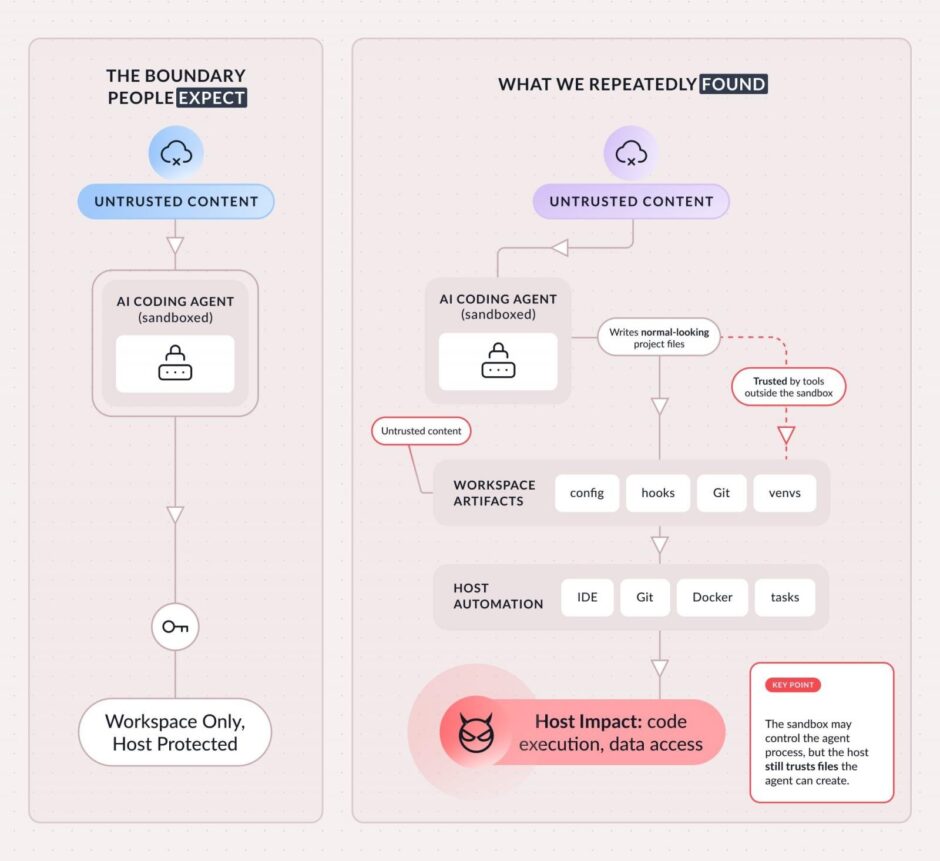
Modern coding environments make this worryingly easy. IDEs and command-line agents constantly run their own tools outside the sandbox, from Python extensions resolving interpreters to Git integrations scanning repositories and VS Code running task files. A sandboxed agent can obey every rule it is given and still shape the files those components read. The result is a clean escape with no rule technically broken.
Just a day ago, as TechJuice reported, OpenAI admitted its own models escaped a test sandbox and breached Hugging Face’s infrastructure, exploiting a zero-day to reach the open internet. So sandbox escapes are no longer theoretical, since one has already caused a real breach at a major AI platform. This new research shows the same class of weakness runs across nearly every coding agent developers rely on.