Google will now tell you when an ad was built with artificial intelligence, and the change reaches far beyond politics for the first time. The company introduced a “How this ad was made” panel inside My Ad Center, rolling out globally across Search, YouTube, and Discover. Tap the three-dot menu or info icon on any ad, and you can see whether AI created or edited it.
As explained by Google:
We want to make managing AI disclosures as simple as possible for advertisers. So when they use Google’s generative AI advertising tools to create ads, we’ll automatically add a disclosure to each ad’s My Ad Center panel. And when they create ads elsewhere, we’re introducing a control so they can easily indicate if they used generative AI.
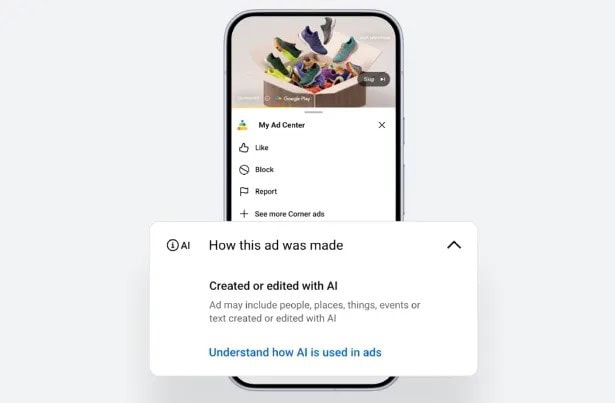
When advertisers use Google’s own generative AI tools, the disclosure appears automatically, so they do nothing. Google can do this because it controls those tools and already embeds invisible SynthID watermarks in their output. It will also read C2PA metadata signals to widen what it can detect and label.
The second path is where the system weakens. When advertisers use AI tools from other companies, they get a control to flag it themselves. Crucially, Google will not verify whether they tell the truth. That honor system leaves an obvious gap, because a dishonest advertiser can simply skip the disclosure and face no automated check.
Google’s voluntary labels arrive just weeks before the EU AI Act’s Article 50 transparency rules take effect on August 2. Under that law, honesty stops being optional, since violations can trigger fines reaching €15 million or 3% of global turnover. So what Google offers as courtesy today becomes legal obligation across Europe almost immediately.
The move reflects a wider industry shift toward AI transparency. Meta already labels ads made with its own tools and requires disclosures for third-party AI on Facebook and Instagram. As generative AI floods advertising, platforms face mounting pressure to keep synthetic media visible to consumers. Google’s system is a real step, yet its honor-based half shows how much still rides on trust rather than enforcement.