
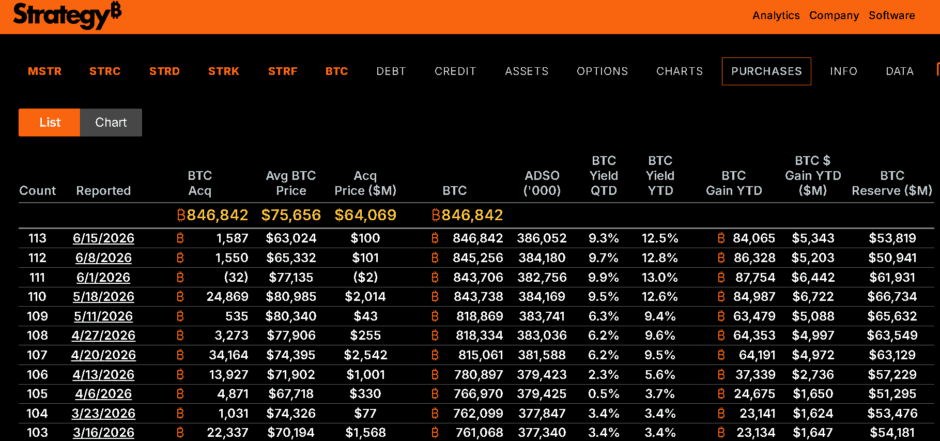
Strategy, the company run by well-known Bitcoin advocate Michael Saylor, bought another 1,587 Bitcoin last week for about $100 million, according to a filing with US financial regulators on Monday. The company paid an average of $63,024 for each Bitcoin in this latest round.
To understand the scale here: Strategy now owns 846,842 Bitcoin in total, worth roughly $56 billion at today’s prices. That is more than 4 out of every 100 Bitcoin that will ever exist, since Bitcoin’s total supply is permanently capped at 21 million coins.
Over the years, Strategy has spent about $64 billion buying all this Bitcoin, averaging roughly $75,656 per coin. Since the current price is lower than that average, the company is technically sitting on about $8.1 billion in paper losses, meaning the value on paper has dropped, even though the company has not actually sold most of its coins to lock in that loss.
This raises an obvious question: why would any company keep buying an asset that has lost value on paper, quarter after quarter, for six straight years? Saylor’s answer comes down to a simple belief that has shaped Strategy’s entire business model since 2020.
He sees Bitcoin not as a stock to trade for short-term profit, but as a long-term store of value, similar to how a country stockpiles gold reserves. His argument is that government currencies slowly lose purchasing power over time due to inflation, while Bitcoin’s fixed supply of 21 million coins means it cannot be diluted the same way.
Under this view, a temporary drop in Bitcoin’s price is treated as noise rather than a reason to sell, since the company is not trying to time short-term swings but to accumulate as much of a permanently scarce asset as possible before more people and institutions catch on. This is also why Strategy reports its progress using metrics like “Bitcoin per share” rather than quarterly profit, since the entire strategy is built around holding, not trading.
That long-term mindset explains why Strategy keeps buying even at a loss, but it does not fully explain why the size of each purchase has shrunk so dramatically. What makes this particular purchase notable is the size, or rather, the lack of it. For most of 2025 and early 2026, Strategy was buying Bitcoin in massive multibillion-dollar chunks. Now, for two weeks running, it has only managed purchases of around $100 million, a fraction of its usual pace.
The reason comes down to how the company raises money for these purchases. Strategy often sells a special type of stock to investors and uses that cash to buy Bitcoin, but that stock has recently dropped below the price level needed to make selling it worthwhile. So instead, the company sold regular shares of its stock to fund this smaller purchase, a slower and less efficient fundraising method than what it normally relies on.
Saylor posted his usual hint on social media over the weekend, a chart captioned “Still adding dots,” which Bitcoin watchers have learned to recognize as code for “a new purchase announcement is coming tomorrow.” This marks the 110th quarter in a row that Strategy has added to its Bitcoin holdings without a single quarter of net selling, going back to 2020.
Saylor has blamed the slowdown on what he calls “AI Summer,” his theory that investor money is currently chasing exciting AI and space company stock listings instead of Bitcoin, and that this money will likely flow back into Bitcoin once that excitement settles down later in the year.
In other words, his explanation is not that demand for Bitcoin itself has weakened, but that the same pool of investor cash is temporarily distracted by flashier opportunities elsewhere, and that Strategy’s own buying power has narrowed simply because its preferred fundraising tool became less attractive for the moment. Whether that theory holds up will likely become clearer by the end of the year, when Saylor expects capital to rotate back toward Bitcoin once the current wave of high-profile listings cools off.