A sharp divergence has opened up inside the crypto ETF market. While investors pull capital out of the funds tracking the two largest cryptocurrencies by market cap, they continue pouring money into ETFs following three altcoins: XRP, Solana, and Hyperliquid’s HYPE token.
XRP ETFs have recorded net inflows in nearly every week since mid-March 2026, with only two red weeks over that entire stretch. Last week added another $10.66 million, bringing XRP ETF cumulative net inflows to a new all-time high of $1.45 billion. Solana ETFs also attracted over $7 million in the same week following a prior red week, confirming that outflows remain the exception rather than the rule.
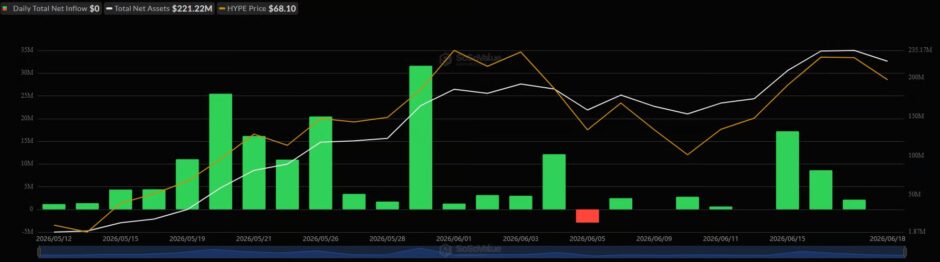
HYPE stands out as the market’s current standout performer at the ETF level. The funds tracking Hyperliquid’s native token launched in mid-May and have not recorded a single red week since their debut, a six-week unbroken inflow streak that includes some of the most volatile and fear-driven weeks the broader crypto market experienced this year. HYPE ETFs pulled in nearly $28 million last week alone, their third-best week on record, and have attracted close to $185 million in net inflows across their six weeks of existence.
The contrast with Bitcoin and Ethereum ETFs is striking. Spot Bitcoin ETFs bled over $226 million in the past week and have now shed roughly $5 billion across the same six weeks in which HYPE and XRP ETFs recorded only positive flows. Ethereum ETFs are in equally poor shape, extending a six-week outflow streak that has pushed total net inflows down by nearly $1 billion.
Whether the divergence reflects seasonal rotation from large-cap crypto into higher-beta altcoins, or a more structural shift in investor appetite away from Bitcoin and Ethereum, remains the central question. The six-week consistency of both trends argues for more than a temporary blip.
Disclaimer: This article is a news report based on publicly available ETF flow data. It does not constitute financial or investment advice. Cryptocurrency markets are highly volatile and readers should conduct their own research before making any investment decisions.