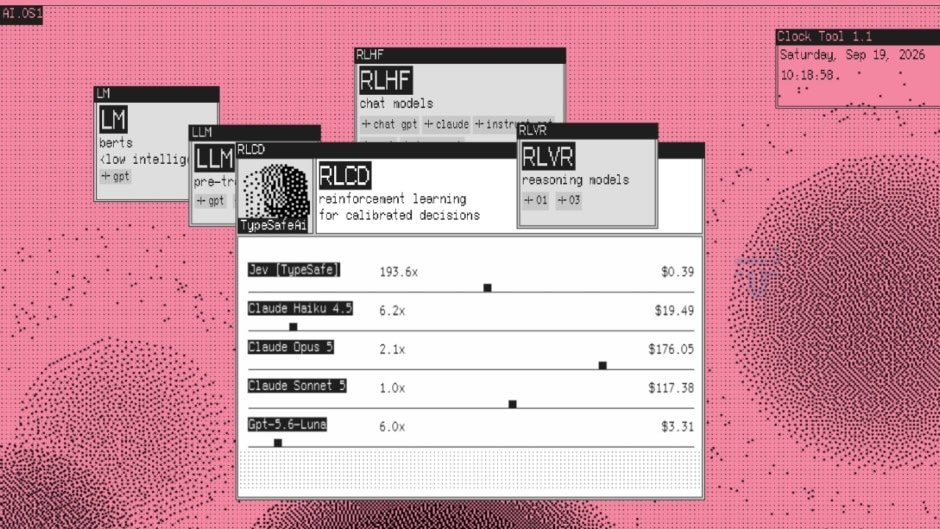
Diogo Almeida left OpenAI frustrated after realizing that despite helping build ChatGPT and inventing reinforcement learning from human feedback, the technology lacked genuine practical utility for real-world automation scenarios and machine-to-machine communication workflows.
Two years ago, Almeida founded TypeSafe AI to solve this fundamental problem, recognizing that ChatGPT optimizes for human-readable language while computers need structured, deterministic outputs that enable genuine automation without requiring human interpretation of results.
This week, TypeSafe launched Jev on September 18 as a breakthrough model designed specifically for automation workflows and classification tasks. The model creates probability scores and calibrated decisions rather than generating text, returning confidence scores between 0 and 1 representing likelihood outcomes. You ask “Is this customer angry?” and Jev returns 0.9, meaning 90% probability of yes.
Jev cannot hallucinate because it outputs numerical probabilities rather than language tokens, and it charges by the billion input tokens rather than counting output tokens like traditional LLMs do. Therefore, Jev costs approximately 100 times less than comparable models, making it viable for high-volume tasks at enterprise scale.
Developers immediately adopted Jev after launch, overwhelming the infrastructure due to extraordinarily high demand. Vercel engineer Pranit Sharma tested Jev against OpenAI’s Luna model and achieved results 5 to 18 times faster while maintaining better accuracy. Bryo AI CTO Nikhil Mudholkar compared Jev to Gemini for classifying business emails, finding Jev cost 10 to 20 times less while returning actual probability scores ideal for automating workflows.
The broader AI landscape shifted dramatically throughout 2026 as specialized models began competing successfully against generalist language models. Decision-makers stopped asking which model is universally best and started asking which model fits their specific cost, latency, and accuracy requirements. A remarkable 625x price gap exists between the cheapest usable option costing $0.04 per million output tokens and frontier models commanding $25 per million tokens.
TypeSafe trained Jev exclusively on synthetic data, which Almeida explained represents his best strategic bet ever made. Synthetic data scaling enables human judgment at scale by automating large portions of annotation and data generation work. Enterprise customers face significant hidden costs after initial AI deployment, with RaftLabs reporting custom AI automation costs $30,000 to $120,000 for 3-10 workflows plus $500 to $8,000 monthly operational expenses.
Pakistani startups should evaluate Jev carefully as a strategic component in their AI automation stacks. Pakistan’s cost-sensitive technology market makes Jev particularly attractive compared to expensive frontier models. Reduced API expenses directly improve unit economics for Pakistani startups building intelligent systems without access to VC funding subsidies, positioning them favorably against regional competitors.