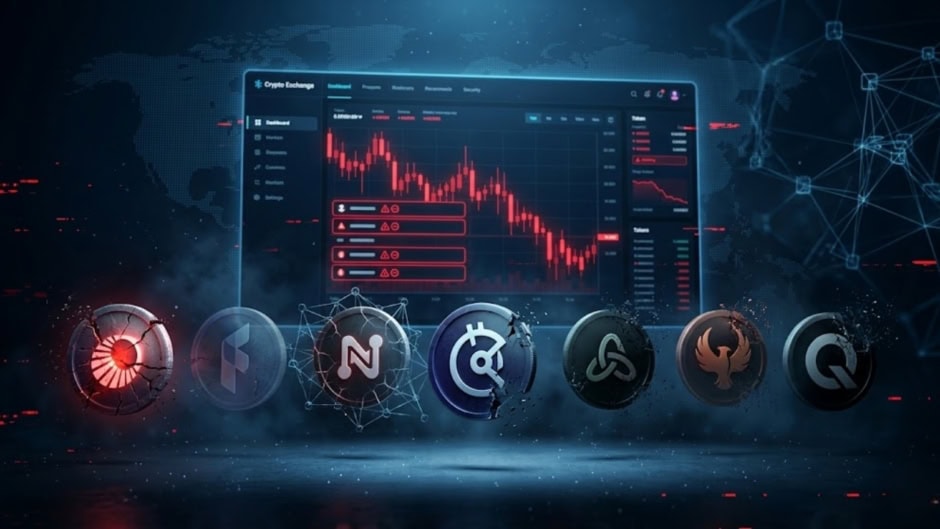
Seven crypto tokens now carry a formal risk warning from Binance, one of the world’s largest cryptocurrency exchanges. The new warning places the seven altcoins under heightened scrutiny and raising the possibility of delisting.
This wave of crypto token delistings in April 2026 has brought renewed attention to how exchanges evaluate the assets they list. Behind every removal is a set of red flags that built up over months or years.
Radiant Capital (RDNT) carries the most visible scar. The DeFi lending protocol suffered a $50 million exploit in October 2024 after attackers compromised its multi-signature wallet system. The protocol never recovered user trust or total value locked. Other major exchanges removed it earlier in 2026, and trading volume has steadily dried up since the hack. A project that cannot demonstrate recovery or meaningful security upgrades after an exploit of that scale faces an uphill battle on any major platform.
FIO Protocol (FIO) has struggled with relevance. The project aimed to simplify blockchain wallet addresses but failed to gain meaningful adoption or maintain active development momentum. Trading volume remained consistently thin, which makes the token increasingly expensive for exchanges to support relative to the liquidity it provides users.
Neutron (NTRN), a Cosmos-based asset, saw its fortunes tied closely to broader Cosmos ecosystem sentiment, which weakened through 2025 and into 2026. Without independent catalysts or strong community activity, the token lost ground both in price and in trading volume.
Gitcoin (GTC) faced a structural challenge. The project shut down its software development arm in early 2025 due to an unsustainable profit model, raising serious questions about long-term viability. A governance token with a shrinking operational base offers little reason for sustained market interest.
Automata Network (ATA), Phoenix (PHB), and BENQI (QI) each reflect a broader pattern of mid-tier tokens that launched during previous bull cycles but failed to sustain developer activity, user growth, or ecosystem relevance into 2026. Trading volumes for all three declined significantly, and community engagement thinned out as attention shifted to newer projects.
Across all seven tokens, the pattern is consistent. Low volume reduces liquidity and makes price discovery unreliable. Weak or stalled development signals that a project has lost direction. Security incidents without credible remediation destroy user confidence. But when exchange support disappears, liquidity collapses fast and token holders bear the full cost.