Every satellite in orbit faces the same fundamental constraint, i.e. fuel. Onboard propellant adds weight, increases launch costs, limits mission duration, and eventually runs out. When it does, the satellite becomes an uncontrollable piece of space debris. In low Earth orbit, where atmospheric drag constantly pulls satellites downward, the fuel problem is even worse because the spacecraft must burn propellant just to stay at its operating altitude.
A European research team has now passed a critical design review on a propulsion system that eliminates this problem entirely. Their air-breathing electric propulsion (ABEP) system captures residual atmospheric particles at very low altitudes and uses them as fuel, turning the very force that drags satellites down into the energy source that keeps them up.
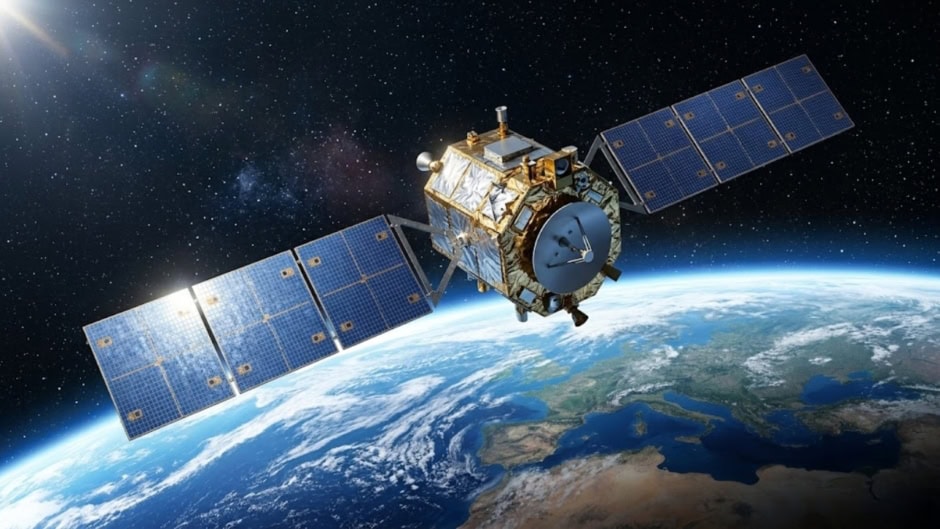
The project, carried out by TransMIT GmbH’s IQM division under European Space Agency funding, has developed a cathodeless electric propulsion thruster designed to operate on nitrogen and oxygen mixtures found in Earth’s upper atmosphere. At altitudes between roughly 180 and 250 kilometers, in what is known as Very Low Earth Orbit (VLEO), trace atmospheric gases are still present. The ABEP system scoops up these particles, ionizes them, and accelerates them to generate thrust.
Traditional ion thrusters rely on cathode assemblies to neutralize the ion beam, but cathodes have proven difficult to implement in air-breathing systems where the propellant is reactive, oxygen-rich atmospheric gas rather than inert xenon. The IQM team solved this by designing a high-frequency ion thruster with cathode-less functional characteristics, removing the cathode assembly entirely while maintaining stable operation.
The system targets at least 50% electrical efficiency and a minimum specific impulse of 4,200 seconds. A prototype is now under construction, with testing planned in vacuum facilities capable of reproducing VLEO conditions. The design builds on earlier feasibility studies and technology trade-offs conducted at IQM that identified the most promising concepts for cathodeless operation in oxygen-rich environments.
The practical implications are substantial. Conventional satellites operating at higher altitudes avoid the worst atmospheric drag but sacrifice image resolution, communication latency, and sensor precision that come from being closer to Earth. Operating at VLEO altitudes would dramatically improve Earth observation capabilities, but until now, the fuel costs of maintaining orbit at those altitudes made long-duration VLEO missions impractical.
An air-breathing system changes the equation fundamentally. Because it uses atmospheric particles that are continuously available at VLEO altitudes, it provides virtually unlimited propulsion for as long as the satellite’s power systems function. The system does not merely compensate for atmospheric drag. It uses the atmosphere itself, the source of the drag, as its propellant. The very particles that would pull the satellite down are captured and expelled to push it forward.
For the satellite industry, the technology opens the door to longer mission lifespans, reduced launch mass, lower operational costs, and an entirely new class of missions at altitudes that were previously too expensive to sustain. Satellite constellations designed for VLEO operation could provide higher-resolution Earth imaging, more responsive communications, and better environmental monitoring without the fuel constraints that currently limit how long and how low satellites can operate.
The design review milestone represents a significant step in European efforts to develop next-generation propulsion systems for sustainable satellite operations. While the technology is still in the prototype and testing phase, the successful review confirms both technical feasibility and readiness for the next stage of development. If the prototype performs as designed under simulated VLEO conditions, air-breathing propulsion could become a standard feature of future low-orbit satellite constellations, fundamentally changing the economics and capabilities of space operations by turning Earth’s atmosphere from an obstacle into an asset.
You can read more about this satellite technology here.